Jun
2026
Why Japan remains one of the markets to watch
DIY Investor
17 June 2026
Saltydog Investor looks at the case for the region.
Of all the developed markets, Japan has probably been hit the hardest by the disruption in the Strait of Hormuz.
Although Japan has been developing its renewable energy capacity, through solar power and nuclear restarts, it is still heavily reliant on imports.
Only around 15% of its energy needs can be satisfied by domestic production. Oil remains its primary energy source, with about 95% of its crude oil imports coming from the Middle East. Most of that would normally pass through the Strait of Hormuz.
In March, following the US-Israeli attack on Iran and Iran’s retaliation across the Gulf states, Japan’s stock markets fell sharply. The FTSE 100 was down 6.7%, while the Dow Jones Industrial Average fell by 5.4%. Germany’s DAX was down 10.3%, but Japan’s TOPIX fell by 11.2%.
The TOPIX covers more than 2,000 companies listed on the Tokyo Stock Exchange and broadly reflects the overall Japanese stock market and economy. The better-known Nikkei 225, made up of 225 of Japan’s largest blue-chip companies, ended the month down 13.3%. That was the worst of the 12 major stock market indices that we monitor each week.
However, following the announcement of the ceasefire in early April, it rallied and continued to perform well in May. This was despite the fact that a negotiated settlement could not be agreed. It was the leading stock market index in our analysis in both months. It went up by 16.1% in April and 11.9% in May.
The Japanese stock market had been performing well before the escalation of tensions in the Middle East. In February 2024, the Nikkei 225 closed above 39,000 for the first time. That broke the previous record set more than 30 years earlier, in December 1989. At the end of February 2026, it closed at 58,850, a further rise of over 50% in just over two years.
After the “two lost decades” of economic stagnation and weak growth, government policy shifted dramatically following the return to office of Prime Minister Shinzo Abe in 2012. He led the country down a path of aggressive monetary easing, flexible fiscal policy and structural reform. These policies were designed to break the country’s deflationary mindset and restore confidence among households, companies and investors.
Although subsequent leaders have refined the approach, the current prime minister’s programme, often referred to as “Sanaenomics”, can be viewed as a continuation of the Abe-era framework. Markets responded favourably earlier this year after Sanae Takaichi called a snap election in January 2026. She became Japan’s first female prime minister in October 2025 and was duly re-elected in the February 2026 general election.
Over the last few years, artificial intelligence (AI) has been the strongest driver for global stock market growth. During 2022 and 2023, it was led by the software companies developing the algorithms and building the data centres. In 2024 and 2025, the focus shifted towards the hardware suppliers.
This not only boosted the Nasdaq, with companies such as NVIDIA Corp NVDA 2.37%, Advanced Micro Devices Inc AMD 7.30% and Micron Technology Inc MU 6.18%, but also led to significant rises in South Korea’s KOSPI. That index is dominated by Samsung Electronics Co Ltd DR SMSN 3.51% and SK Hynix.
The Nikkei 225 also includes several companies linked to the AI infrastructure theme. They range from Tokyo Electron and Advantest in semiconductor equipment, to Kioxia in memory, and Fujikura and Furukawa Electric in fibre-optic cables. It also includes SoftBank, through its technology investments. This is another reason why it has performed so well in recent months.
The US and Iran have now agreed a framework deal to end the war and reopen the Strait of Hormuz. The Nikkei 225 almost immediately went up by around 5%.
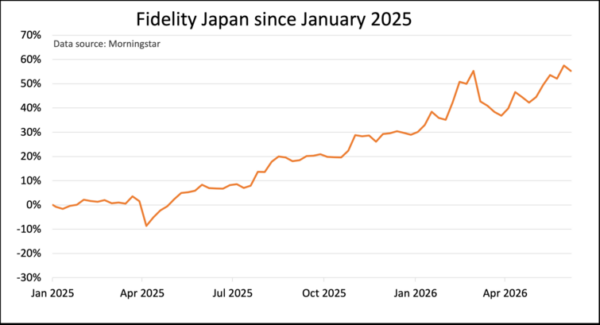
We have held the Fidelity Japan W Acc (B882N04) fund in one of our demonstration portfolios since last August. It has been one of our best-performing funds, and we hope that now the situation in the Middle East has improved, it will continue to do well.
For more information about Saltydog, or to take the two-month free trial, go to www.saltydoginvestor.com
Leave a Reply
You must be logged in to post a comment.