Nov
2026
When is a bubble not a bubble?
DIY Investor
23 November 2026
For months, media commentators have been sounding the alarm that stock markets are somewhere in the middle of an artificial intelligence (AI) bubble that will do more damage even than the dotcom boom and bust at the start of the millennium if and when it bursts.
Yet this overlooks the fact that some parts of the AI trade are already well into bear market territory. If you want a more in-depth read on tech stocks’ current wobbles, you can read my colleague’s excellent recent note.
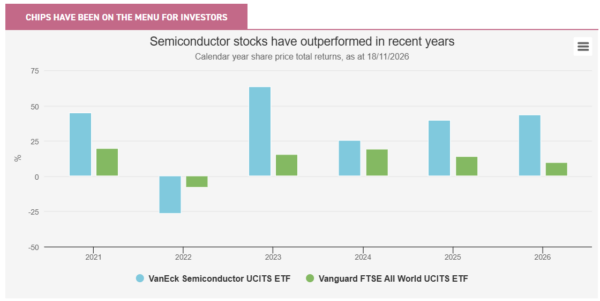
Until the middle of the year, the semiconductor sector was seen as the big winner from AI, given demand for their products (the small, silicon microchips used in much of what needs power to run) was soaring. In each of the past four full calendar years, the annual total returns from the VanEck Semiconductor UCITS ETF (SMGB), which tracks a basket of companies up and down the semiconductor chain, had well outpaced global indices.
Chips have been on the menu for investors
Source: FE fundinfo
Past performance is not a reliable indicator of future results
Since late June, however, we’ve seen a reversal of this performance. SMGB’s share price fell c. 32% between 22/06/2026 and 17/11/2026 – hit largely by the scandal surrounding NVIDIA’s now-former CEO Jensen Huang.
Elsewhere, neoclouds, the specialist cloud computing companies that rent out high-performing computing power to other businesses, have also been hit. Yields on the bonds issued by CoreWeave have soared as high as 15% as bond investors doubt whether it can stay solvent, taking down the firm’s share price at the same time, with c. 74% of its value wiped off since June 2025.
Given we’ve been told to expect a faltering of the AI trade to take down both global economies and world stock markets, punching a hole in the retirement plans of millions, one might be surprised to hear that despite all this, the Vanguard S&P 500 (VUAG) and Vanguard FTSE All-World UCITS ETFs are down just 1% and 3.3% respectively between 22/06/2026 and 17/11/2026.
The Invesco EQQQ Nasdaq 100 UCITS ETF, which is more heavily weighted to tech and AI, has fallen into correction territory, down c. 10.6% – but none of this is catastrophic. Of course, there could be further to fall, but what we seem to be seeing today is a broadening out of market performance at the expense of big AI names.
Broadening out
That’s good news for those of us who have hitherto been wary of the AI boom, given a number of equity markets have held up well, meaning you haven’t had to sacrifice returns for safety. Happily, of the 15 best performers, I count five within my portfolio.
Top performers during AI sell-off
| Investment trust | Share price total return (22/06/2026-17/11/2026) |
| Onward Opportunities (ONWD) | 34.50% |
| Gresham House Energy Storage (GRID) | 31.70% |
| Syncona (SYNC) | 30.80% |
| Tetragon Financial (TFG) | 25.60% |
| Greencoat UK Wind (UKW) | 21.20% |
| NextEnergy Solar Fund (NESF) | 20.00% |
| Finsbury Growth & Income (FGT) | 19.90% |
| VPC Specialty Lending (VSL) | 18.30% |
| Artemis UK Future Leaders (AFL) | 17.70% |
| Aberforth Smaller Companies (ASL) | 16.60% |
| Rights & Issues (RIII) | 16.30% |
| The Renewables Infrastructure Group (TRIG) | 13.90% |
| Target Healthcare REIT (THRL) | 13.60% |
| Temple Bar (TMPL) | 13.50% |
| 3i Group (III) | 13.40% |
Source: FE fundinfo
Past performance is not a reliable indicator of future results
There are two clear winning sectors: UK smaller companies and renewable infrastructure energy. We’ve been banging the drum for both of these sectors for a while now, so this doesn’t surprise us.
In fact, we would argue that one of the most underappreciated trends we’ve seen recently is the outperformance of UK markets. The Vanguard FTSE 250 UCITS ETF is up c. 27.2% in the two years to 17/11/2026, versus a c. 21.9% return from VUAG.
UK small- and mid-caps have been shunned thanks to more than a decade of relentless selling pressure, particularly from domestic investors, as well as pessimism over the state and path of the UK economy. While we accept that these are troubling, the depressed valuations provide investors with a margin of safety hard to find anywhere else in the world. In addition, international investors have re-entered the market, as shown by the multitude of UK companies being acquired at bargain prices by overseas buyers.
The unashamedly value approach of Aberforth Smaller Companies (ASL), which stays true to a tried-and-tested process that has been in place since the trust’s 1990 inception, has paid off. ASL’s portfolio of out-of-favour and undervalued UK small-caps has helped it benefit from the M&A trend.
On the renewables front, we feel that investors are finally seeing the value that’s on offer there. It’s another sector where sentiment has been badly hit, understandably, given the sharp increase in government bond yields we saw through 2022. However, we suspect that pain is well behind us and the yields on offer from the sector look compelling.
Greencoat UK Wind (UKW), for instance, offers an attractive dividend yield of c. 8.8%. That’s a c. 3.5 percentage point premium to the 10-year gilt yield, while UKW’s dividend also has an explicit link to consumer price inflation and is well covered. We recently wrote about the
calculated evolution of UKW’s investment process, which we feel adds to its appeal.
Top performers in David’s portfolio
| Investment trust | Share price total return (22/06/2026-17/11/2026) |
| Greencoat UK Wind | 21.20% |
| IFSL Evenlode Global Equity | 18.20% |
| Artemis UK Future Leaders | 17.70% |
| Aberforth Smaller Companies | 16.60% |
| Latitude Global | 14.70% |
| Temple Bar | 13.50% |
| 3i Group | 13.40% |
| Odyssean (OIT) | 12.60% |
| Ranmore Global Equity | 12.40% |
| Fidelity Special Values (FSV) | 10.10% |
Source: FE fundinfo
Past performance is not a reliable indicator of future results
Aside from the overlap, one other theme I’ve noticed is the return of true, quality growth investing. After decades of strong performance – and the making of a number of so-called ‘star’ fund managers such as Terry Smith and Nick Train, as well as, arguably, the conversion of Warren Buffett, the quality style of investing has fallen out of favour, akin to the way value did as growth and momentum dominated the post-financial crisis landscape.
Don’t call it a comeback
True quality growth has underperformed for a while now, notably lessening the influence of the likes of Train and Smith. Indeed, Finsbury Growth & Income (FGT) has had a particularly tough time, heavily underperforming its benchmark.
Yet, we’ve seen a reversal in these headwinds since June, suggesting the quality growth style isn’t dead – as value investing has proven not to have died, either.
Train and co-manager Madeline Wright have been focusing on AI, but eschewing the direct beneficiaries (the UK has few of these, of course) and instead finding high-quality companies with banks of proprietary data that can harness AI to help clients use this data more efficiently and in ways they have not envisaged in the past.
A couple of funds from my own portfolio that fit in with this style are IFSL Evenlode Global Equity (the largest position in both my ISA and SIPP), and Latitude Global.
Again, UK names dominate my top performers, too, with the value-oriented styles of Fidelity Special Values (FSV) and Temple Bar (TMPL) coming into their own.
I’m glad that all of the funds in my portfolio that have delivered a double-digit share price total return (bar UKW) are invested in equities and I’m hoping it means they will fare well if this really is the slow grind down in the AI trade that it could be.
Still, being at least 18 years away from being able to access my SIPP, I’ve tried to position my portfolio to be as optimistic and invested in equities as possible, while maintaining a c. 12.5% cash buffer just in case. Some of that recently found its way into Allianz Technology Trust (ATT)and the WS Blue Whale Growth fund.
I see both as direct AI plays, given their big weightings to chipmakers, but also diversified enough to have some downside protection at the same time. Indeed, ATT is a highly active fund run by an experienced management team that can go anywhere up and down the technology stack and, with shares having fallen c. 20% and trading on a c. 8% discount, they looked good enough value to top up.
This performance data encapsulates, of course, a short period of time in stock market history and it’s possible that if and when the AI story does reverse, it takes most markets down with it. However, I see this as a good stress-test exercise to carry out every now and again and, without getting too complacent, I am happy with how my portfolio is positioned for the many potential eventualities ahead.

Disclaimer
This is not substantive investment research or a research recommendation, as it does not constitute substantive research or analysis. This material should be considered as general market commentary.
Leave a Reply
You must be logged in to post a comment.