Sep
2026
They Said Buy: What happens to stocks after a YouTube recommendation?
DIY Investor
26 September 2026
An investment video can make a persuasive case in minutes. Checking that case takes a little more patience: the original words, the date they were spoken, and what happened afterwards.
By Mike, founder of They Said Buy
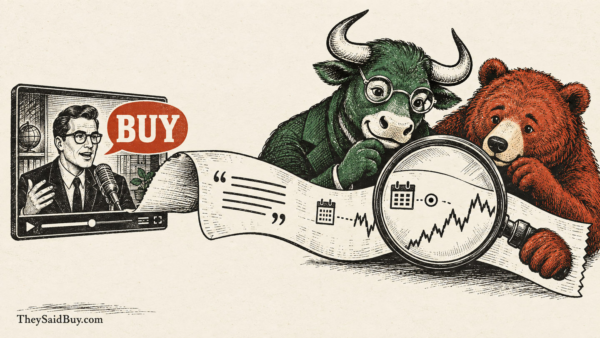
Follow the idea from the original video to the dated evidence and the price movement that followed.
You finish watching a video about a company. The presenter knows the business, the growth story sounds convincing, and the shares look interesting. Before long, you are reading the comments and wondering whether to buy.
There is another useful step to take first: go back through the evidence.
What did the creator actually say? At what price did they say it? Did they describe a purchase, offer a valuation, or suggest something they might do if circumstances changed?
These are the questions behind TheySaidBuy.com, an independent project that brings together dated statements from investing YouTubers, links to the original video moments, and the share-price movements that followed. It gives readers a way to revisit an investment idea after the video has slipped out of the feed.
Start with the words
Consider three hypothetical statements about the same company:
- “I own shares in this business.”
- “I think the shares could be worth $150.”
- “I would consider buying if the price fell below $100.”
Each contains useful information. Each also means something different.
The first describes a holding at a particular moment. The second offers an estimate that depends on the speaker’s assumptions. The third sets a condition that may never be met.
Treating all three as an instruction to buy would lose much of what the speaker was trying to communicate.
The surrounding discussion matters, too. A confident sentence may be followed by an explanation of the risks, a five-year time horizon, or a warning that the current price is too high. Following the link back to the video lets you hear those qualifications.
A useful question to ask yourself is: could I explain this person’s argument fairly, including the circumstances in which it might fail?
Give the opinion a date
An investment argument belongs to a particular moment.
A company can become more expensive while its prospects improve. It can also become cheaper because something important has gone wrong. Hearing the same positive description several months apart does not mean the opportunity is unchanged.
The date helps you reconstruct what was knowable when the opinion was expressed. It also helps separate the original argument from events that only became clear later.
This is particularly useful when revisiting a successful idea. Looking back, it is easy to focus on the eventual winner and forget the uncertainty that existed along the way. A dated record gives you somewhere concrete to start.
See how a real example unfolds
The Tom Nash and Amazon timeline shows how this works in practice.
It brings together statements made about Amazon on different dates, including a February 2026 selection as a stock pick, an April discussion of the company’s prospects and a July discussion of buying the dip. The entries link to the relevant moments in the original videos and place them alongside subsequent price movements.
A reader can choose an earlier statement, hear the reasoning, then move forward through the record. That makes it easier to examine how the argument developed as the share price and circumstances changed.
The archive has a defined scope: it contains selected statements from the videos reviewed. Checking that coverage is part of reading the evidence fairly.
Put the price movement in context
Suppose, in a hypothetical example, a share rises from $100 to $112 after a video appears. That is a 12% price increase.
Now suppose the wider market rises 18% over the same period.
Both numbers are useful. Together, they give you more context than the share-price move alone. A broad market rally may explain part of what happened; the company’s own news and the risks it carried still deserve attention.
They Said Buy presents stock-price changes alongside SPY, the exchange-traded fund that tracks the S&P 500, over matching dates. The calculations use closing prices adjusted for share splits. The methodology explains the starting points and limitations.
These figures describe price movement. An investor’s actual return also depends on when they traded, position sizes, dividends, costs and taxes. A published opinion does not reveal all of those details.
The time horizon matters as well. Six months of price action gives an incomplete answer to an argument made about the next five years.
Turn viewing into research
A useful habit is to write a short note before acting on an idea. Include:
- The argument: what needs to happen for the investment to work?
- The evidence: which claims can you check in the company’s reports?
- The price and date: what was being offered when the idea caught your attention?
- The risk: what could undermine the argument?
- The review point: which future results or events would make you reconsider?
Then return to that note when new information arrives. You can examine whether the business developed as expected and whether your own reasoning held up.
The same approach helps when assessing a creator’s work. Look for how clearly they explain assumptions, acknowledge uncertainty and respond to changing evidence. One successful call, or one unsuccessful one, offers only a small part of that picture.
Investment videos can introduce businesses and perspectives you would otherwise miss. Keeping the original words and their dates makes those ideas easier to examine over time.
The next time a compelling stock idea catches your attention, keep a record of it.
The video may last twenty minutes. Your decision could stay with you for years.
Alternative investments Commentary » Brokers Commentary » Commentary » Equities Commentary » Latest » Take control of your finances commentary
Leave a Reply
You must be logged in to post a comment.