Aug
2026
The UK funds roaring back to life
DIY Investor
11 August 2026
Saltydog Investor has added a handful of UK funds – but not out of patriotism
The best-performing Investment Association (IA) sector in July was UK Equity Income. It was followed closely by UK All Companies, and then UK Smaller Companies.
That momentum has carried on into August.
During the first week, UK Equity Income gained a further 1.4%, while UK All Companies and UK Smaller Companies rose by 1.6% and 2.3% respectively.
We have also recently seen the FTSE 100 and FTSE 250 reaching record levels: the FTSE 100 set a new intraday high, while the FTSE 250 reached both a new intraday high and a record closing high.
As part of our regular weekly analysis, we look at the relative performance of a wide range of funds.
To help our members compare funds which have had similar levels of volatility in the past, we put them into our Saltydog groups.
The least volatile group, “Safe Haven”, only contains funds from the two Money Market sectors.
Next is the “Slow Ahead” group, which includes £ High Yield, £ Strategic Bond and £ Corporate Bond, along with some of the mixed investment sectors.
The most adventurous funds, from sectors like Technology & Technology Innovation, Global Emerging Markets and US Smaller Companies, fit into the two “Full Steam Ahead” Groups.
Sandwiched between “Slow Ahead” and “Full Steam Ahead” is our “Steady As She Goes Group”. This is home to the funds from the three UK equity sectors.
Where we only analyse a few funds from an IA sector, we often combine them. For example, the UK Gilts and UK Index-Linked Gilts sectors. The Global and Global Emerging Market Bonds figure is calculated by taking an average of all the non-UK bond sectors.
When we looked last week, the leading sectors from the “Steady As She Goes” Group had gone up by 2% in the previous week. The UK Equity Income sector topped the table based on its four-week return, and was also ahead over 12 and 26 weeks.
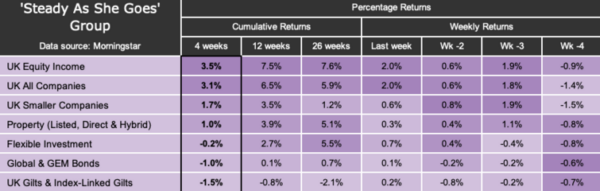
We provide data on the top-performing funds in each sector, based on varying timescales. We also calculate a decile ranking based on how each fund has performed within its Saltydog group.
When we are selecting funds for our demonstration portfolios, one of the things we look for is funds which are currently in decile one over four, 12 and 26 weeks. There were five in last week’s reports. Four were from the UK Equity Income sector and one from the UK All Companies sector.
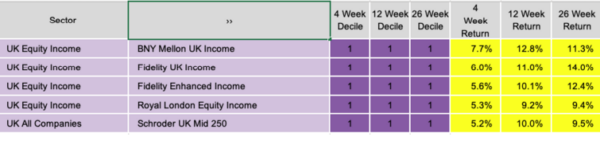
The top two, BNY Mellon UK Income GBP Inc (0677921) and Fidelity UK Equity Income W INC (B3LNGT9), were also in decile one for the previous individual week.
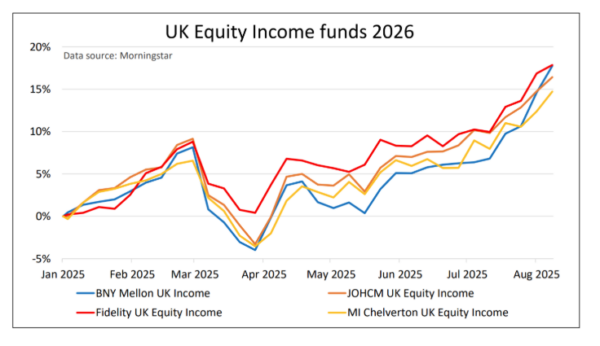
For most of this year, our demonstration portfolios have had relatively little exposure to the UK equity sectors. Our Ocean Liner portfolio invested in the JOHCM UK Equity Income IP GBP Acc (B8FCHK5) fund in mid-January, and for several months that was it.
All three sectors suffered significant losses in March. UK Smaller Companies fell by 11.4%, UK All Companies dropped 8.1%, and UK Equity Income ended the month down 7.6%.
Although they recovered during April and May, we felt more comfortable holding on to funds from the “Slow Ahead” group. Over the first half of this year, the Mixed Investment 40-85% Shares sector outperformed all three UK equity sectors.
However, when the UK Equity Income sector started coming to the fore in July, our Tugboat portfolio invested in the MI Chelverton UK Equity Income B Acc (B1Y9J57) fund.
Last week, it added the Fidelity UK Income fund, and the Ocean Liner welcomed the BNY Mellon UK Income fund aboard.
Across the two portfolios, we now hold four funds from the UK Equity Income sector.
As UK investors, there are several reasons why investing in funds from the UK equity sectors can be appealing.
Funds investing predominantly in UK-listed shares can reduce much of the direct foreign currency exposure associated with overseas equity funds.
However, it is important to realise that the risk is not eliminated, as UK-listed companies can often generate substantial revenues overseas.
UK investors may also have greater familiarity with the country’s political, regulatory and economic environment, including the effects of interest rates, taxation, housing, consumer confidence and government policy. This can make the investment case easier to understand and assess.
UK equities, particularly smaller companies, have at times traded at substantial discounts to larger overseas markets, potentially creating opportunities for long-term investors.
However, valuation discounts can persist and do not guarantee superior returns. It can also feel good to be supporting domestic businesses, although allowing patriotism to influence investment decisions too much could lead to excessive home-market bias.
For us, the important point is that the recent increase in our UK exposure has come from what we are seeing in the data. As always, we will continue to monitor each fund’s performance and assess whether its returns remain appropriate for the risks being taken.
For more information about Saltydog, or to take the two-month free trial, go to www.saltydoginvestor.com
Leave a Reply
You must be logged in to post a comment.