Jul
2026
The Times They Are A-Changin,: “London Calling”
DIY Investor
27 July 2026
 “London calling to the faraway towns
Now war is declared, and battle come down”
It seems strange to be reviewing Burnham after a week in-office, but we now live in an instant world.
My editor told me, “I don’t recall people demanding a new broom – Labour won by a landslide not only because people hated the Tories, but because people bought into its manifesto”.
Yes, Labour did win a huge majority based on voters hating the Tories, but, this was skewed by our electoral system and Reform splitting the right-wing vote.
Some did buy into the manifesto, but most just wanted “change.”
Burnham’s start summed up the differences. He started by delivering optimistic messages, whereas Starmer decided to cut winter fuel payments.
But, to fully set the scene, what are the electorates preferences? According to Ipsos, they are; the economy, immigration, health and defence.
In “Does PM Burham Stand A Chance?”, I wrote about how Labour have successfully set about dealing with immigration, people smugglers, asylum decisions and number of people housed in asylum hotels.
Therefore, I’m ignoring immigration.
The issue is the economy, specifically the cost-of-living.
‘The issue is the economy, specifically the cost-of-living’
This has an ongoing issue, started by the GF C, and exacerbated by wars in Ukraine and Iran.
Following the crisis, median earnings decreased in real terms across age groups. In April 2025, real median pay was 12% higher than in 2008 level among 18-20 year olds and 27% higher for 16-17 year olds. For other age groups, real earnings only just returned to 2008 levels in April 2025.

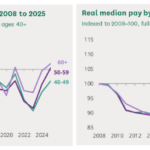
Source: https://commonslibrary.parliament.uk/research-briefings/cbp-8456/
At present, the cost-of-living crisis is greatly impacted by Trumps war with Iran. The one that was supposed to last a few weeks but is now entering its sixth month.
And almost every household in the world is feeling the impact of this foolishness.
Brent oil is now almost 40% higher than before the war, whilst gas prices have soared again in the UK, up nearly 50% just this month.
One of Burnham’s big proposals is levelling-up, dealing with our regional differences
One way he proposes to do this is by revising the community charge. In his interview with Laura Kuenssberg for the BBC’s Panorama programme, he said: “There are people here in Greater Manchester who pay a much higher council tax than people living in much larger homes in London”.
Responding to this, James Cleverly, the shadow housing secretary, accused Andy Burnham of planning “more ways to tax Middle England”.
Cleverly said: “Andy Burnham and Labour are just looking for more ways to tax Middle England, and raise taxes on people’s homes.
“Replacing council tax and stamp duty with a new house price tax would not be a tax cut for hardworking families – quite the reverse: people across England would end up paying more.”
One suggestion is for a land value tax (LVT), as proposed by Dan Neidle’s Tax Policy Associates.
‘almost every household in the world is feeling the impact of this foolishness’
The scheme would replace the £45.2bn raised by council tax and the £11.5bn from stamp duty with a flat LVT rate of 1.28%, which would raises £56.7bn. By his calculation, about 70% of homes pay less than their current council tax. These homes are mostly outside London and the south-east.
Underpinning the idea is the fact that the super-rich wouldn’t be unable to dodge the tax because they cannot shift the land they own overseas.
Source: https://taxpolicy.org.uk/wp-content/assets/lvt_model/index.html
At this point I find myself in the strange situation of agreeing with a Tory shadow-ministers, Perhaps, I am returning to my One Nation Tory roots.
Cleverley is right, this is simply a whack to middle-England, it is levelling down.
‘Let’s try this one: independence for London and the SE!’
Myself, and I imagine many others don’t actually care.
Andy is big on devolution. Let’s try this one: independence for London and the SE!
The harsh truth is that people in London and the SE earn more, but the cost of living in the is significantly higher than the national average, driven primarily by housing, transport, and localized service costs.

Source: https://commonslibrary.parliament.uk/research-briefings/cbp-8456/
The average property price in London is C.£660,975, in the SE it is C.£465,000, whereas the broader UK average is C.£300,000.
Rents in London average £2,000-2,700, Brighton often range from £1,200 to over £1,800 for smaller apartments, far in excess of other parts of the country.
Food and utilities are little difference with the exception of council tax.
Transport costs are higher due to a reliance on rail and road transit into London, with annual travel passes significantly higher than in regional UK counties.
As a result, disposable income in lower in London and SE for the majority. Forget the uber rich, this is based on the median wage.
| Region | Median Wage £ | Disposable Income £ |
| London | 41,800 | 5,200 |
| SE | 36,200 | 8,400 |
| East of England | 34,500 | 9,400 |
| Scotland | 34,100 | 11,200 |
| NW (incl. Manchester) | 32,600 | 10,700 |
| Yorkshire & the Humber | 31,800 | 11,600 |
| NE | 31,200 | 12,100 |
| Wales | 31,000 | 11.859 |
| West Midlands | 32,200 | 10,600 |
Source: https://careermetrics.co.uk/blog/cost-of-living-vs-salary-uk-regions/
In summary, out of the 9-regions, the supposed wealthy parts aren’t wealthy, they are just running hard to stay still.
But, what of Burnham’s first week?
He’s been positive, delivered somethings that are immediate, tangible and uncomplicated; lower energy bill, cheaper bus fares. All comparatively cheap to fund, although the media was quick to compare this to Trussonomics, even though the cost is about £44bn less.
For some, this was a “small solution to big problems”. Whereas Burnham sees this as the start of what he achieved in Manchester: “We built a city-region with twice the economic growth of anywhere else in the UK. What we did in Greater Manchester, we can do across the nation.”
New research from the Harvard Kennedy School and King’s College London, authored by Ed Balls and others, argues that Britain’s national productivity problem is a function of its “persistent regional productivity problem”, with the divide between the SE and the rest leading to “productivity gaps wider than between east and west Germany”.
Surely, the issue here is that the SE produce more and end up worse-off?
If you consider tax revenues, in the financial year ending 2023, the total revenue appears to be £1,082bn. Of which London and SE contributed £434bn, 40% of the total.
Source: Section 4. “Revenue from the countries and regions of the UK”
Levelling-up for London and SE, perhaps?
“The wind howls through the empty blocks looking for a home
I run through the empty stone because I’m all alone” (2)
Notes:
1&2. “London Calling” and “London’s Burning” by The Clash
I decided to pick-up on your comments from last week, and consider Burnham’s position and the ongoing challenges.
As you might expect, initially he has done little more than fiddle around the edges. There has been nothing like Gordon Brown passing interest rate setting to the BoE.
But, this is the lull before the storm.
Much expenditure is required: defence, health, and climate change.
I have to admit defence leaves me cold. We will waste money on long-term projects that fight the last war and can be destroyed by drones costing a tiny percentage of what we spent.
Who will we fight? Russia is a spent force; Ukraine has done for them. China? No. Trump’s America is more likely.
If there is a battle, it is climate change. We could create jobs, wealth, save the planet and become energy independent. There has to be a catch?
Levelling-up will do for Burnham, London and the SE will turn blue, with bits of LibDem orange.
Andy is big on devolution. Let’s try this one: independence for London and the SE!
Lyrically, it’s the Clash, “London Calling” and “London’s Burning.”
Oh joy!
Philip.
@coldwarsteve
 Philip Gilbert is a city-based corporate financier, and former investment banker.
Philip is a great believer in meritocracy, and in the belief that if you want something enough you can make it happen. These beliefs were formed in his formative years, of the late 1970s and 80s
Click on the link to see all Brexit Bulletins:

Leave a Reply
You must be logged in to post a comment.