Dec
2025
Schroder Income Growth: the quiet power of compounding income and active management
DIY Investor
25 December 2025


A case study in long-term investing – 30 years of rising income and market-beating performance
According to legend, when the Indian scholar Sissa ben Dahir presented his invention of chess to his King, he asked for a humble reward – one grain of wheat on the first square of the board, two on the next, then doubling with each successive square. The King agreed, amused by such a modest request, until the numbers began to multiply. By the time they reached the 64th square, the total owed would have emptied the royal granaries many times over.
This is a parable about exponential growth and the power of compounding. It captures one of investing’s quietest truths – that steady, incremental gains, when left to compound, can produce impressive long-term investment outcomes. That’s why Albert Einstein called compounding “the eighth wonder of the world”. What looks ordinary in the moment can, over time, become extraordinary.
‘steady, incremental gains, when left to compound, can produce impressive long-term investment outcomes’
That same principle lies behind the long-term success of the Schroder Income Growth Fund plc. With a 30‑year history of consecutive dividend increases, the trust has quietly demonstrated what compounding can achieve. Since its first full financial year in 1996, the trust has steadily grown its dividend at an annualised growth rate of 4.1%. That may not sound like much, but with the benefit of compounding, it is enough to transform a dividend of 4.35p per share in 1996 to 14.70p per share in its recently completed 2025 financial year, comfortably ahead of the rate of inflation over this period. That track record owes as much to disciplined stock selection as it does to the mathematics of compounding – it is the product of successful active management across shifting market cycles.
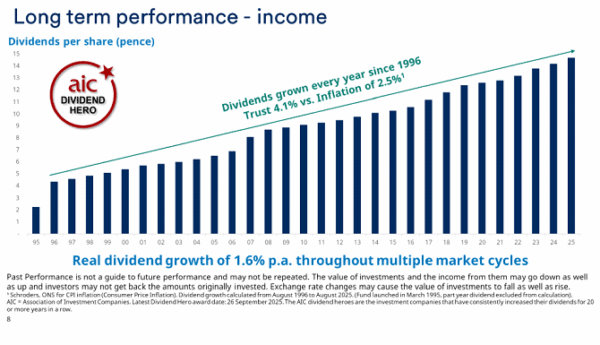
How compounding works in practice
Dividends are the unsung hero of long-term returns. Reinvested steadily, they can make a greater difference to wealth than many investors realise. Schroder Income Growth was built around that principle. Its investment objective is to provide real growth of income – in excess of the rate of inflation – and capital growth as a consequence of the rising income.
The investment trust structure plays a key role in making that possible. The trust can hold back a portion of its income in strong years and use it to support dividends when times are tougher. Those reserves have proved invaluable – they helped smooth Schroder Income Growth’s payout through the global financial crisis of 2007-09 when many other funds were forced to cut their dividends. And again, during the Covid pandemic, the trust used its reserves to maintain its record of dividend increases through a period in which UK dividend payments as a whole collapsed.
‘a framework that is ideal for capturing the long-term benefits of compounding’
Meanwhile, the investment trust structure means Schroder Income Growth can also use modest borrowing to enhance returns when valuations look attractive. Together, those features create a framework that is ideal for capturing the long-term benefits of compounding. Indeed, over the trust’s 30-year history, the combination of a disciplined investment approach, astute stock selection and the investment trust structure has delivered returns comfortably ahead of the wider UK equity market – a track record that is built on more than just patience.
A pragmatic and resilient approach
 Sue Noffke, portfolio manager of the Schroder Income Growth Fund plc, and Head of UK Equities at Schroders, since 2011, pursues an investment approach that is pragmatic and valuation-led.
She looks for companies with strong cash flows and balance sheets to sustain long-term dividend growth, but she’s not confined to any one style or sector.
Sue builds the portfolio using a ‘barbell’ philosophy – one side is anchored by established, higher-yielding businesses that provide reliable income, the other is in companies, often younger and smaller, that have the potential to grow rapidly over time. That mix allows the trust to balance present income with future growth.
The approach has been tested several times during the challenging market conditions of recent years, yet it continues to underpin the trust’s long-term outperformance. The same discipline extends to how the board governs the trust on behalf of its shareholders. For example, the annual management fee was recently reduced from 0.45% to 0.40%, to the lower of market capitalisation or NAV, and separate secretarial and administration fees have been removed.
An ideal environment for income investors
Meanwhile, the UK has become one of the most attractive and dependable sources of equity income anywhere in the world. Its listed market offers an attractive mix of domestically focused companies and large, globally diversified businesses, allowing managers to adjust the balance as the opportunity set evolves. Many of these firms are also in robust financial shape, with strong balance sheets and good cash generation.
Importantly, valuations are also very appealing currently, both in the context of history and when compared to other regions. Recently, Sue has been finding more opportunities further down the market cap spectrum among mid and small sized companies, where valuations are particularly low and long-term prospects under-appreciated.

At the same time, UK management teams have become more disciplined in how they deploy capital to take advantage of the undervaluation of their shares. Many are increasingly using share buybacks alongside regular dividends to enhance shareholder returns. On a total shareholder yield basis, combining both dividends and buybacks, the UK market is difficult to match.
With its flexible mandate and active stock picking approach, Schroder Income Growth is well placed to capture these opportunities – combining the depth of the UK market with Sue’s proven ability to select companies offering a suitable blend of income, value, growth and resilience.
The lasting rewards of consistency
As Sissa’s chessboard reminds us, small gains can build into something remarkable over time. The same holds true for Schroder Income Growth, whose 30-year record of rising dividends has earned it a place among the Association of Investment Companies’ ‘Dividend Heroes’.
‘the UK has become one of the most attractive and dependable sources of equity income anywhere in the world’
That recognition reflects the trust’s enduring strengths – a disciplined investment approach, careful stock selection, the benefits of the investment trust structure and a clear alignment between the board, the manager and shareholders. Together, these qualities have allowed the trust to deliver real growth in income and last value for investors.
After three decades, the numbers tell their own story. What began as a modest annual payout has compounded into one of the most consistent income records in the market – a quiet demonstration of what patience and active stock selection can achieve.
Visit the Schroder Income Growth Fund plc homepage >
Find out more about the Schroder Income Growth Fund
Please remember that the value of investments and the income from them may go down as well as up and investors may not get back the amounts originally invested.
This marketing material is for professional clients or advisers only. This site is not suitable for retail clients.
Issued by Schroder Unit Trusts Limited, 1 London Wall Place, London EC2Y 5AU. Registered Number 4191730 England.
For illustrative purposes only and does not constitute a recommendation to invest in the above-mentioned security / sector / country.
Schroder Unit Trusts Limited is an authorised corporate director, authorised unit trust manager and an ISA plan manager, and is authorised and regulated by the Financial Conduct Authority.
On 17 September 2018 our remaining dual priced funds converted to single pricing and a list of the funds affected can be found in our Changes to Funds. To view historic dual prices from the launch date to 14 September 2018 click on Historic prices.
Saver > Investor Magazine Issue 1

See the new issue here >
Leave a Reply
You must be logged in to post a comment.