Aug
2026
Report reveals how long it takes to save for a 20% home deposit around the world in 2026
DIY Investor
12 August 2026
Getting onto the property ladder in 2026 seems like a race against house prices: across the EU, house prices rose by 53% between 2015 and 2024, according to the European Parliament, while recent research in the UK has found that rising property prices have already pushed the time needed for first-time buyers to save a deposit further out of reach. In light of the deteriorating housing affordability in much of the world, I am reaching out with our latest report, revealing how long would-be homebuyers actually have to work to save for a down payment.
To answer this question, the team at BestBrokers compared average home prices with gross incomes across countries and calculated how many months of income would theoretically be needed to cover a standard 20% home deposit. We included the latest average home prices and income figures for 130 countries, with the full dataset available on Google Drive via this link.
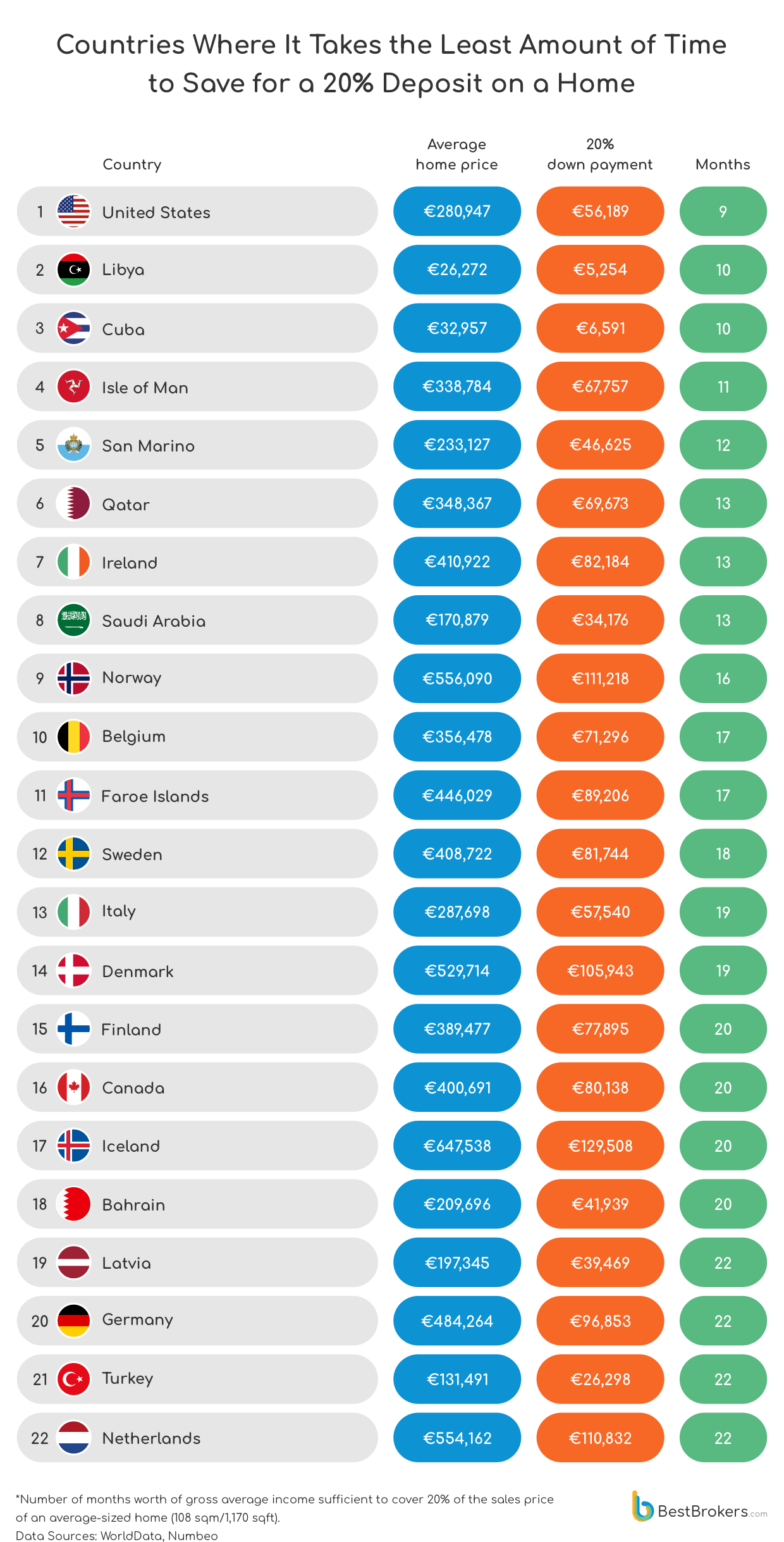
The comparison shows that the United States is the country where it is easiest to save for a home deposit, with a 20% down payment requiring just 9 months of gross average income. According to Numbeo price data, the average-sized home in the country costs the equivalent of €280,947, so a 20% deposit comes at €56,189.
Several African countries occupy the bottom of the affordability ranking, with Burundi presenting an almost unimaginable contrast – the theoretical saving period for a 20% home deposit reaches 2,595 months, or more than 216 years. Meanwhile, the Isle of Man offers the best affordability levels in Europe since the same 20% down payment equates to just 11 months’ worth of gross income.
This is where saving for a 20% home deposit takes the longest time across Europe:
(based on average housing prices and local gross monthly income)
- Moldova: 71 months of income (€580/month) to save for a €41,322 deposit
- Ukraine: 56 months of income (€397/month) to save for a €22,337 deposit
- Kosovo: 55 months of income (€560/month) to save for a €30,829 deposit
- Bosnia and Herzegovina: 53 months of income (€716/month) to save for a €37,651 deposit
- Montenegro: 51 months of income (€1,020/month) to save for a €52,314 deposit
- Serbia: 51 months of income (€971/month) to save for a €49,776 deposit
- Albania: 50 months of income (€869/month) to save for a €43,035 deposit
- North Macedonia: 46 months of income (€684/month) to save for a €31,389 deposit
- Belarus: 46 months of income (€660/month) to save for a €30,174 deposit
- Croatia: 40 months of income (€1,828/month) to save for an $83,645 deposit
And these are the European countries where the equivalent of a 20% deposit can be earned the fastest:
- Isle of Man: 11 months of income (€6,274/month) to save for a €67,757 deposit
- San Marino: 12 months of income (€3,886/month) to save for a €46,625 deposit
- Ireland: 13 months of income (€6,297/month) to save for a €82,184 deposit
- Norway: 16 months of income (€7,014/month) to save for a €111,218 deposit
- Belgium: 17 months of income (€4,288/month) to save for a €71,296 deposit
- Faroe Islands: 17 months of income (€5,270/month) to save for a €89,206 deposit
- Sweden: 18 months of income (€4,542/month) to save for a €81,744 deposit
- Italy: 19 months of income (€3,033/month) to save for a €57,540 deposit
- Denmark: 19 months of income (€5,564/month) to save for a €105,943 deposit
- Finland: 20 months of income (€3,982/month) to save for a €77,895 deposit
- Iceland: 20 months of income (€6,431/month) to save for a €129,508 deposit
Here are a few key takeaways from the report:
- Our analysis shows that the United States offers the best housing affordability in the world when both prices and incomes are taken into account. Americans earning the average gross income ($7,401 or around €6,402/month) would have to set aside just 9 months’ worth of income to save for a home deposit – the average-sized home in the country costs the equivalent of €280,947. And 20% of this amount comes at approximately €56,189.
- At the bottom of the ranking, the East African country Burundi has the worst housing affordability, at least based on reported home prices (€2,063/sqm on average) and local gross income. The 20% deposit amounts to roughly €44,888, equivalent to the gross local income for a staggering 2,595 months.
- Home affordability varies significantly across Europe, with residents of the Isle of Man having to work for only 11 months to cover the 20% deposit, the fastest saving rate among European countries. Meanwhile, Moldova offers the worst affordability levels – a 20% home deposit is equivalent to 71 months’ worth of income.
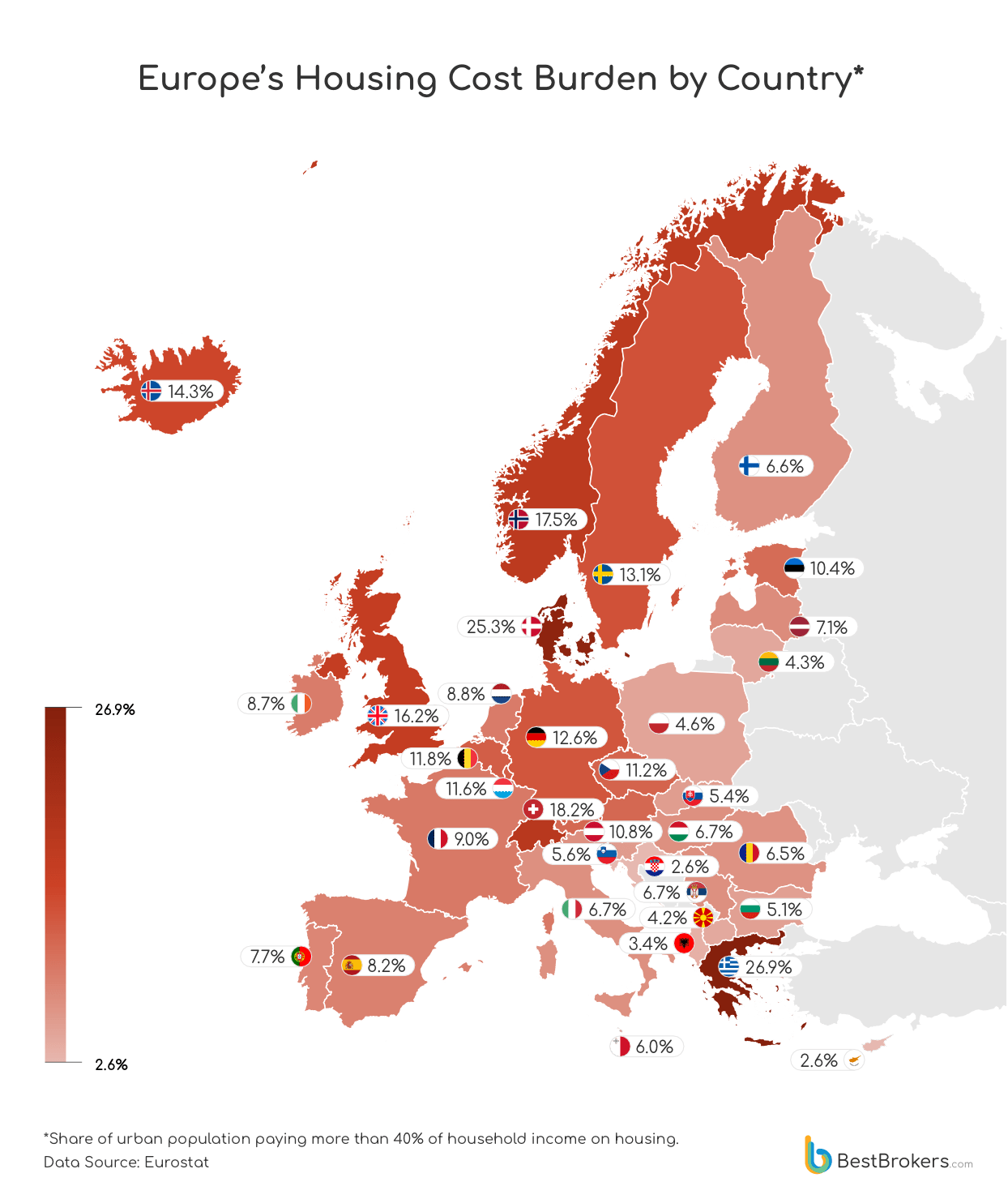
- Greece has the highest housing cost burden in Europe, with 26.9% of its urban population spending over 40% of household income on housing, according to figures from Eurostat. Denmark comes next at 25.3%, followed by Switzerland (18.2%), Norway (17.5%), and the UK (16.2%). Europe’s lowest levels of housing burden can be seen in Croatia and Cyprus, where only 2.6% of urban residents spend more than 40% of their household income on housing.
- The research also looks at what would happen if buyers attempted to purchase an average home outright rather than simply saving for a deposit. In the United States, the full purchase price is equivalent to around four years of gross annual income, while in Burundi it reaches an extraordinary 1,081 years.
‘Over the past few years, the global housing problem has escalated to a housing crisis, particularly in some European countries and Asian megacities where new construction fails to keep up with demand. The question has moved from simply whether people can afford to buy a home to whether they can afford to live where they work – without housing swallowing an uncomfortable share of their income, whether these costs would be rent or mortgage.
House prices across the EU were still rising by 5.1% year-on-year in the first quarter of 2026, while rents increased by 3%, showing that the pressure on households has hardly disappeared. The picture is, however, extremely uneven – for younger Europeans in particular, saving for a deposit while paying high rent can feel like trying to fill a bucket with a hole in it – as soon as some money is put aside, rising housing costs and everyday expenses eat into it. A 20% deposit may be a useful benchmark, but for households already stretched by rent, building that savings pot is far more difficult than the numbers suggest. Ultimately, Europe’s housing crisis is not just about expensive property; the key issue is what ordinary households can realistically afford to pay.’
– comments Alan Goldberg, lead analyst and author at BestBrokers.
The figures are theoretical and assume that someone could put 100% of their gross income towards the deposit, without spending anything on food, rent, utilities, transport, taxes or other necessities. In real life, therefore, the time required would be considerably longer. We estimated the average home size around the world, using sizes in square meters and square feet from The Globe and Mail article. Data was sourced frоm Numbeo, WorldData, and Eurostat as of August 6 2026.
More information about the cross-country comparison and housing affordability, including the methodology and calculations, is available in the full report. The data we have gathered and used for the estimates can be accessed on Google Drive via this link. Feel free to use any data or graphics for publication by providing proper link attribution to the original report.
Paul Hoffman
BestBrokers.com

Leave a Reply
You must be logged in to post a comment.