May
2026
Kepler rates the best trading platforms for DIY investors in 2026
DIY Investor
27 May 2026
We put the best trading platforms under the microscope…by Jo Groves
There’s a price war going on in the world of trading platforms and retail investors are in the driving seat.
For years, the Harrods of investing had captured the hearts (and wallets) of two million clients happy to pay a little extra for Hargreaves Lansdown’s rather distinguished offering. But even the greatest of bastions have to move with the times, with HL announcing sweeping fee cuts at the start of the year, marking its first major pricing overhaul in over a decade.
Despite HL stating that most clients would pay the same, or lower fees, rivals appeared to be the bigger beneficiaries. interactive investor reported net inflows up nearly 90% year-on-year, trumpeting its success across “And to a certain competitor who recently changed their fees, thank you” posters on the London Underground. With AJ Bell also adding 50,000 new customers in a single quarter, it seems that HL’s overhaul may just have prompted investors to start shopping around.
And a near £600 billion market does tend to attract a crowd. With dozens of providers now competing for your business, headline fees may have drifted downward, but there’s often a sting in the tail. Foreign exchange fees, inactivity charges and fund dealing costs have a habit of quietly eroding the savings promised by zero-commission headlines.
Fortunately, that’s where we come in. We’ve reviewed and ranked the top platforms on fees, investment choice and customer support to help you find the best fit for your needs, along with answers to all your burning questions in the FAQs below.
Why fees are the silent killer
Returns may get the glory, but fees do the damage and, unlike markets, they’re the one thing you can control. The chart below shows how the gap between the cheapest and most expensive platforms in our group can add up to thousands of pounds in fees over time.
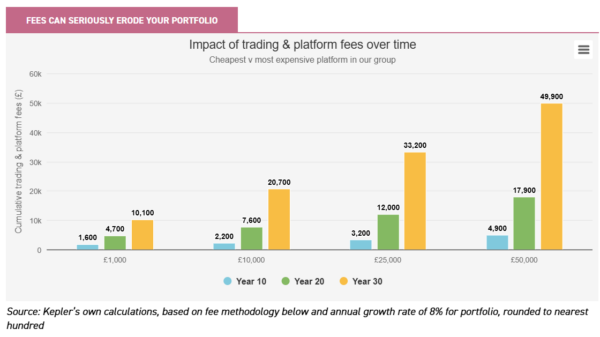
On a £50,000 portfolio, choosing the most expensive platform over the cheapest would cost nearly £50,000 in lost returns over 30 years (equal to the original investment). The impact is even more severe on smaller portfolios due to the fixed trading fees, with a £1,000 portfolio sacrificing £10,000 in returns by the 30-year mark.
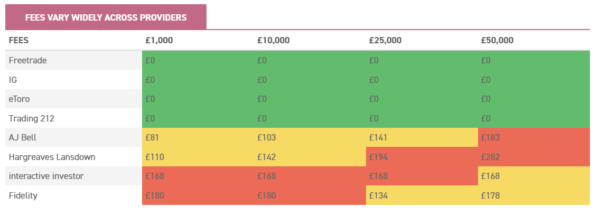
You’ll find full details of fees below, but the following table gives a quick snapshot of fees by provider, with green being the cheapest and red the most expensive:
The best trading platforms
These are our pick of the best trading platforms, with the methodology for the fee calculations explained below.
Why we picked it
Why we picked it
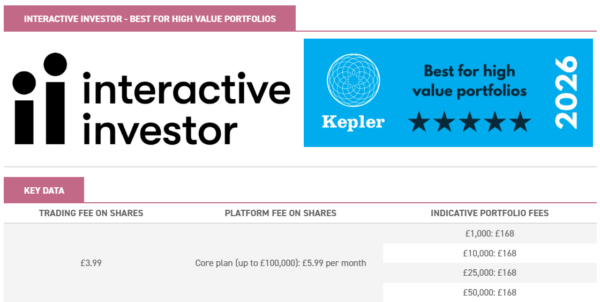
Owned by fund manager Aberdeen, interactive investor (ii) has built a following of over 500,000 clients on the back of a flat monthly, rather than percentage-based, fee, which rewards higher-value portfolios in particular.
Its investment range is one of the broadest in our group, with over 40,000 options spanning 17 international markets, including over 3,000 funds, 1,000 ETFs and 300 investment trusts, alongside a curated ‘Super 60’ shortlist. There are no fractional shares, but multi-currency accounts help reduce the sting of repeated currency conversions for those investing outside the UK.
Plans are as follows:
- Core: £5.99 per month, trading fee of £3.99 for funds and shares, FX fee of 0.75%
- Plus: £14.99 per month, trading fee of £1.49 for funds and £3.99 for shares, one free monthly trade, FX fee of 0.75% for trades up to £50,000
- Premium: £39.99 per month, no fee for funds and £2.99 for shares, two free monthly trades, FX fee of 0.25%
A 4.5-star Trustpilot rating puts it in solid mid-table territory on customer satisfaction, with support available by phone and online. Where ii genuinely excels is content, with its research and educational tools among the best on the market.
Overall, ii is a natural home for investors with higher-value portfolios looking for a flat-fee structure, broad investment range and quality research all under one roof.
Why we picked it
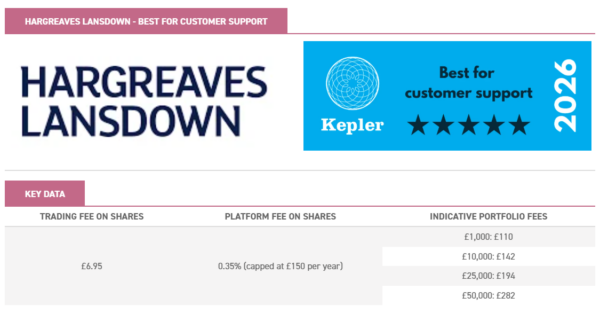
Hargreaves Lansdown (HL) needs little introduction, with its two million customers making it the UK’s largest investment platform by some margin.
HL offers the fullest suite of accounts in our group, including ISAs, SIPPs, Junior ISAs, Junior SIPPs, Lifetime ISAs and bare trusts. It also boasts one of the broadest investment ranges, with over 8,000 shares, 4,000 funds, 1,900 ETFs and 300 investment trusts across UK, European and North American markets. Investors looking for ideas can also browse the Wealth Shortlist (HL’s curated selection of funds) or opt for one of its ready-made portfolios.
Where HL genuinely stands apart is customer service. Its UK-based helpdesk is available by phone and online, with knowledgeable advisers and an average hold time that puts most rivals to shame. It may sit mid-table with a 4.4-star Trustpilot rating, but for investors who want a real person at the end of the line rather than a chatbot, HL takes some beating.
HL had a significant fee overhaul in early 2026, cutting its share trading fee from £11.95 to £6.95 and platform fee from 0.45% to 0.35%. The trade-off was a new £1.95 trading fee on funds and a higher cap of £150 (up from £45) on the platform fees for shares.
Fees for the Fund and Share Account reflect its premium positioning:
- Platform fee:
- Shares: 0.35%, capped at £150 per year
- Funds: 0.35% up to £250,000, falling to 0.25% and 0.10% thereafter
- Trading fee:
- Shares: £6.95, falling to £3.95 for investors making 20 or more trades in previous month
- Funds: £1.95
- FX fee: 0.99% on trades up to £10,000
HL is one of the more expensive options, particularly for frequent traders, but for investors who value service, range and reputation above all else, it remains a difficult proposition to beat.
Why we picked it
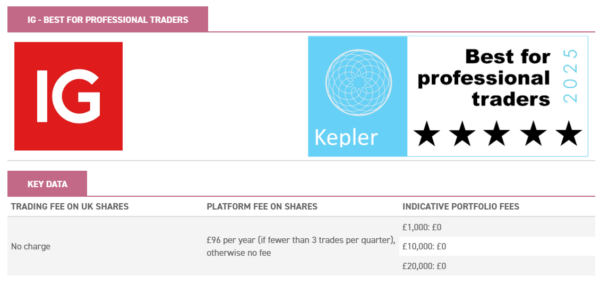
FTSE 100 company IG is one of the UK’s better-known trading platforms, with over 340,000 active clients worldwide.
The investment range is comprehensive, with over 12,000 shares and investment trusts across UK, US, European, Asian and Australian markets, plus over 3,000 ETFs, but no actively-managed funds or fractional shares. The IG Smart Portfolio option provides access to a range of BlackRock ETFs, and the platform integrates with MetaTrader 4, ProRealTime and TradingView for more advanced traders.
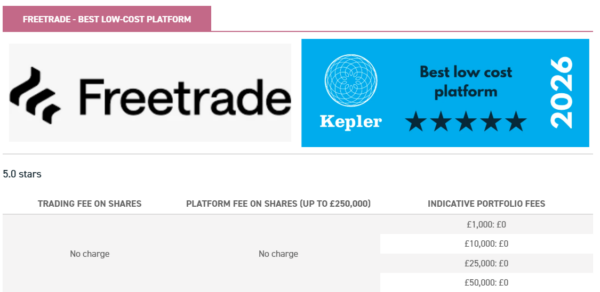
Where IG stands apart is cost, as follows:
- Platform fee: no charge
- Trading fee: no charge
- FX fee: 0.7%
Customer service is available by phone and live chat, and the IG Academy provides a good range of educational content and market research. However, the elephant in the room is IG’s 3.8 Trustpilot rating, with the most frequent gripe being slow response times.
IG is best suited to experienced investors seeking a low-cost platform with sophisticated tools and a broad range of investments, though beginners are likely to be better served elsewhere.
Why we picked it
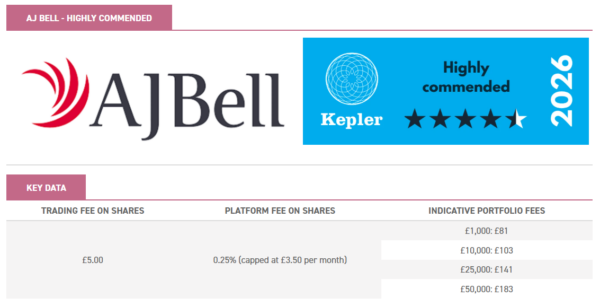
A FTSE 250 company with over 720,000 clients, AJ Bell has built a strong all-round offering, combining a broad investment range, competitive fees and excellent customer service.
The investment range is one of the widest in our group, with over 16,000 UK and international shares across 24 markets, alongside more than 4,600 ETFs, 4,500 funds and 300 investment trusts – though no fractional shares. Investors looking for inspiration can tap into the 70-strong Favourite Funds list, or opt for one of AJ Bell’s starter portfolios for a more hands-off approach.
Unlike ii’s flat-fee model, AJ Bell charges a percentage-based platform fee, which suits smaller portfolios but becomes less competitive as your pot grows. Fees are as follows:
- Platform fee:
- Shares: 0.25%, capped at £42 per year
- Funds: 0.25% up to £250,000, falling to 0.10% thereafter
- Trading fee:
- Shares: £5.00, falling to £3.50 for investors making 10 or more trades in the previous month
- Funds: £1.50
- FX fee: 0.75% on trades up to £10,000
AJ Bell tops the Trustpilot table among our selected providers with an impressive 4.9-star rating, and it earns it: support is available by phone and online, and its research library and monthly podcasts are genuinely excellent. For those who prefer a simpler experience, the Dodl app offers a more streamlined investment universe at a lower cost.
AJ Bell is an excellent all-rounder, with competitive fees, a broad investment choice and strong customer service.
Why we picked it
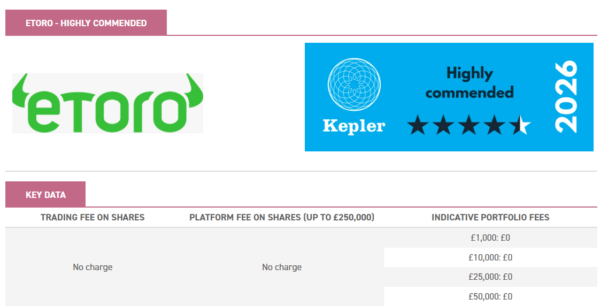
eToro is a global fintech platform with over 40 million registered users, best known for its CopyTrader feature, which allows investors to replicate the trades of other users in real time, a unique offering that sets it apart from more traditional platforms.
The investment range spans over 6,000 stocks across 20 exchanges and 300 ETFs, alongside commodities and currencies, with fractional shares also available. Smart Portfolios offer a ready-made portfolio alternative, in partnership with Franklin Templeton, WisdomTree and BlackRock.
Fees are competitive for UK investors:
- Platform fee: no charge
- Trading fee: no charge for shares or ETFs
- FX fee: varies by tier and payment method
- Inactivity fee: $10/month after 12 months with no logins
Customer support is available only online, which may frustrate some investors, but the eToro Academy does provide a solid range of educational content for beginners. However, its Trustpilot rating of 4.2 is towards the lower end of our group, with customers flagging concerns with the online help function.
Overall, eToro suits frequent traders drawn to its social and copy trading features, with a broad global stock range, sophisticated app and no trading fees for UK investors, though it’s worth keeping an eye on the inactivity fee.
Why we picked it
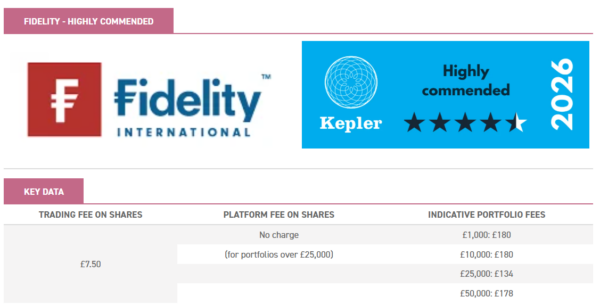
Fidelity has over 1.7 million customers in the UK and offers a wide range of third-party funds alongside its own.
The investment range is solid (but not the broadest), with over 2,400 shares, 2,900 funds, 500 ETFs and 160 investment trusts, but no fractional shares. Investors looking for guidance can browse the Select 50 shortlist of expert-picked funds, or opt for one of Fidelity’s ready-made portfolios.
Fidelity charges a single platform fee based on total portfolio value across all accounts, which benefits larger portfolios:
- Platform fee:
- Shares: no charge
- Funds: 0.35% up to £250,000, falling to 0.20% thereafter. A platform fee of £90 is charged for portfolios under £25,000 without a regular savings plan.
- Trading fee:
- Shares: £7.50
- Funds: no charge
- FX fee: 0.75% on trades up to £10,000
Customer service is a genuine strength, with its phone and live chat support earning it a Trustpilot rating of 4.5. It also offers a face-to-face investor centre in London, a rarity among the online providers.
Overall, Fidelity works best for investors with larger, fund-heavy portfolios who can make the most of the tapered, non-tiered fee structure. However, the £90 flat fee for smaller portfolios (without a regular savings plan) is expensive, and the £7.50 share trading fee is unlikely to find favour with active traders.
Methodology
Our selection is based on three core criteria: competitive trading and platform fees, a broad range of third-party investments and a strong Trustpilot rating. We also factored in our own experience of each platform, the availability of accounts such as ISAs and SIPPs, and the quality of customer support.
Indicative fees are calculated on the following basis:
- Portfolio split: 50:50 between funds and shares
- Trading activity: 24 trades per year, split equally between funds and shares
- Portfolio values: £1,000, £10,000, £25,000 and £50,000
Frequently asked questions
What is a trading platform?
A trading platform allows investors to buy and sell shares, funds, investment trusts and exchange-traded funds (ETFs) directly rather than through a financial adviser or traditional stockbroker. Often called a DIY platform or online brokerage account, it’s essentially a way to hold and manage your investments in one place.
You can place trades online or via an app with real-time access to your portfolio. Fees are usually lower than using an adviser or broker, and many platforms offer educational tools and curated fund shortlists to help you build your portfolio.
What fees should you watch out for?
It’s important to understand the fees involved as these can significantly impact your returns over time. There are three main types of fees:
- Platform fee: This is a fee for holding investments on the provider’s platform, usually a percentage of your total portfolio value (typically 0.25%-0.45% per year). Platform fees may be capped at a maximum amount per year and can vary according to whether you hold share-based investments (company shares, ETFs and investment trusts) or funds. Alternatively, some providers offer a flat or no fee. Platform fees are usually tiered, meaning that you’ll pay a lower platform fee on the portion of your portfolio over certain thresholds, for example, 0.25% up to £250,000, then 0.1% on the portion between £250,000 to £500,000 and no fee on the portion above £500,000.
- Trading fee: You’ll typically pay a trading fee of £4 to £12 for buying shares (including ETFs and investment trusts), although some platforms offer commission-free trading. Trading fees for funds are generally lower, or often zero, and frequent traders often pay a lower fee, usually based on the number of trades in the previous month or quarter.
- Fund management fee: As mentioned below, you’ll pay an annual management fee for investing in funds, which is typically between 0.1% and 1%.
What type of trading account should you consider?
While we’ve focused on general trading accounts, it’s worth looking at tax-efficient wrappers like ISAs and SIPPs. These allow you to invest without paying income tax on dividends or capital gains tax on profits.
Some (though not all) of the platforms listed also offer ISAs and SIPPs alongside general trading accounts. We’ve also produced guides on the best ISA providers, best Junior ISA providers and best SIPP providers.
How do you open a trading account?
Opening a trading account is usually straightforward and can often be done online in around ten minutes. You’ll need to provide some basic details, including your bank account and National Insurance number. Most checks are carried out electronically, though you may be asked to upload documents for verification purposes.
Once you’ve deposited funds into your account, you’re ready to start trading. You can trade shares live when stock markets are open. For the London Stock Exchange, this is 8:00am to 4:30pm UK time. For US markets such as the Nasdaq and NYSE, normal trading hours are 9:30am to 4:00pm Eastern Time, which is typically 2:30pm to 9:00pm UK time (depending on daylight saving).
What can you invest in?
A trading platform gives you access to a wide range of investments to suit different goals and risk levels. Most providers offer UK and US shares, with some also covering European, Australian or Asian markets.
Another option is funds which pool your money with other investors to invest in a portfolio of assets. There are two main types of funds:
- Actively-managed funds: These are professionally managed by fund managers who pick a basket of investments such as equities, bonds or commodities. These typically charge a higher annual management fee of 0.5% to 1.0%.
- Passively-managed funds: Also known as index, tracker or ETFs, these track an index such as the FTSE 100 or S&P 500, although there are more specialist options tracking commodities and property indices. Fees are usually lower, at around 0.1% to 0.5%.
If you’d prefer a more hands-off approach, platforms also offer:
- Ready-made portfolios tailored by risk level and managed on your behalf.
- Robo-advisers, which use an online questionnaire to build an automated portfolio based on your goals.
- Financial advisers offering personalised advice, though this is usually the most expensive route.
How much money do you need to open a trading account?
This depends on the platform, but many allow you to open an account with as little as £1 (or £25 a month for monthly investing). You’ll need to add further funds to the account depending on the cost of the investment you’re purchasing.
Can you buy US shares on a UK trading platform?
In short, yes. You’ll typically pay a trading fee and a foreign exchange fee to convert pounds to dollars. You’ll also need to complete a W-8BEN form (valid for three years) to benefit from a reduced US dividend withholding tax rate of 15% instead of 30%.
Foreign exchange (FX) fees vary widely across the platforms we reviewed, ranging from 0.15% to 1.50%. If you paid a 1.0% FX fee on a £1,000 purchase of US shares, you’d be charged £10 to convert your money into dollars. Some platforms offer multi-currency accounts, which can reduce the need for repeated currency conversions when trading in overseas investments.
It’s also worth remembering that holding US shares exposes you to currency risk. If the pound strengthens against the dollar, your investment may fall in value when converted back to sterling, even if the share price rises in dollars.
Do you pay tax on profits made through a trading platform?
When you buy UK shares, you’ll usually pay Stamp Duty Reserve Tax (SDRT) at 0.5% of the transaction value. This doesn’t apply to overseas shares (though other taxes may apply).
If you sell shares for a higher price than you paid for them, you may have to pay capital gains tax on the profit. The current capital gains allowance is £3,000 (for the 2025-26 tax year), meaning that capital gains below this amount should be tax-free.
You may also pay income tax on dividends. The current dividend allowance is £500 in addition to your annual personal allowance of £12,570 (in the 2025-26 tax year).
No income or capital gains tax is payable on investments held in ISAs, SIPPs or Junior ISAs.
What are fractional shares?
Fractional shares allow you to buy part of a share, such as 0.5 or 0.25, rather than a whole share. You’ll receive a share of any dividends paid and benefit from any increase in the share price.
Not all platforms offer fractional trading, but it can be a handy option if you’re investing smaller sums. A case in point is Berkshire Hathaway’s Class A shares, which trade at hundreds of thousands of dollars each (and frankly, it would be cheaper to pick up a flat in London…).
Is your money safe on a trading platform?
When choosing a trading platform, you should check the FCA register to ensure that your platform is authorised. This means that you should have access to the Financial Ombudsman Service and the Financial Services Compensation Scheme (FSCS) if an issue arises.
The Financial Ombudsman Service will consider complaints against trading providers and may be able to resolve your complaint if the firm fails to deal with it properly.
The FSCS will consider claims if your trading provider goes out of business and owes you money; however, it relates only to certain investment products. If the product is covered, the FSCS can pay up to £85,000 per investor.
It’s worth checking the protection offered by your trading platform: some platforms are structured so that investments are held in ‘trust’ to protect them in the event of the firm running into financial difficulties.
It’s also important to remember that your investment can go down as well as up, and you may not get your money back. Investing in a diversified portfolio of shares via a fund, investment trust or ETF may help reduce your exposure to an individual company underperforming.
However, if you are unsure as to the right option for your circumstances, you should seek independent financial advice.
What is the best trading platform for beginners in the UK?
The best platform depends on your needs, but most beginners look for low fees, a user-friendly app, solid educational tools and access to UK and US stocks.
Some platforms offer virtual portfolios, which are an ideal way to build your investing skills without risking real money. Many providers also provide free guides and webinars, which are often available even if you’re not a customer.
It’s also worth considering the level of customer support. While zero-commission apps tend to offer online-only help, mainstream providers such as HL and AJ Bell also offer phone support, which can be helpful if you’re just starting out.
How does monthly investing work?
Monthly investing allows you to invest a fixed amount (usually a minimum of £25 per month) into shares, funds, or ETFs. Your money is automatically invested on a set date each month, helping you build your portfolio gradually without needing to time the market.
It’s a good way to benefit from pound-cost averaging, whereby you can buy more units when prices are low and fewer when they’re high. Some platforms offer discounted trading fees for monthly investing, making it a cost-effective option for long-term investors.

Disclaimer
This is not substantive investment research or a research recommendation, as it does not constitute substantive research or analysis. This material should be considered as general market commentary.
Leave a Reply
You must be logged in to post a comment.