Oct
2026
Get Rich Slowly: Don’t dream it’s over
DIY Investor
25 October 2026
Our investment specialist tackles AI euphoria, space fever and more earthly pursuits…by Jo Groves
One of my supremely middle-aged pleasures is wandering around my local library (and the more stuck in a time warp, the better). Having recently moved back to London, I braced myself for something rather less capacious, though what it lacked in space, it made up for in performative homework supervision. After exhausting the chick lit, I found myself drawn to the investing section and its smorgasbord of How to Make Yourself Rich offerings.
As an aside, encouraging more women to invest is unquestionably a good thing, but titles such as Girls Just Wanna Have Funds aren’t exactly helping the cause. How to Be a Rich Old Lady by Amanda Holden looked more promising – until it transpired it wasn’t that Amanda Holden and was rather more about asset allocation than the benefits of wearing very little on prime-time television.
Parking that searing insight, there was a certain irony in finding Personal Finance parked next to Paranormal. That said, building wealth through psychic powers may well offer better odds than some of the get-rich-quick schemes masquerading as investment wisdom.
Alas, the rest of us mere mortals are left to make the best decisions we can with the information available. The joy of writing this column is that my decisions are preserved in black and white, ready to come back and haunt me, so I’m revisiting a few of last year’s convictions to see whether they’ve hit or missed the mark.
Are we paying too much for US exceptionalism?
Last December, I was wanging on about a possible AI bubble. That debate is still raging but NVIDIA (NVDA) has continued to confound the doom-mongers. Revenue growth of more than 100%? Tick. Beating analyst earnings forecasts for 15 consecutive quarters? Tick. Yet its share price has chalked up a rather more pedestrian one-year gain of just under 20%.
When I was pondering whether to take profits on NVIDIA a year ago, the analyst 12-month price target of 39% persuaded me to hold fire. Surely, sell-side caveats aside, analysts who live and breathe a sector know more about it than the average retail investor? So I crunched the same numbers for the other big US tech names.
The answer is perhaps not, given the gulf between price targets and actual returns in both directions. Meta (META) and Microsoft (MSFT) barely made it into positive territory despite targets implying 30%-plus gains, while the reverse was true for Alphabet (GOOGL) and Apple (AAPL). So much for that particular crystal ball.
Should share price targets come with a health warning?
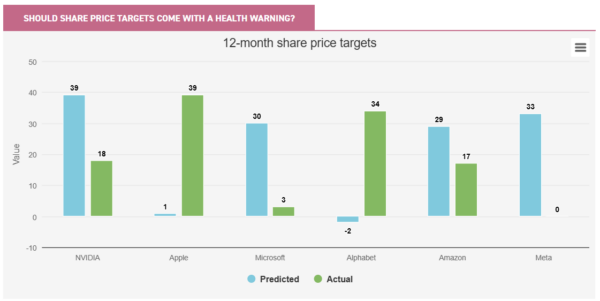
Source: FT data. Analyst price targets as at 10 December 2025, actual share-price returns for year ending 19 October 2026.
Past performance is not a reliable indicator of future results.
Fears over stretched valuations may persist, but strong earnings growth has significantly reduced some of the Magnificent Seven’s multiples since last December. NVIDIA’s trailing price-earnings ratio has fallen from 45x to 27x, with Alphabet dropping from 32x to 17x. While that doesn’t necessarily make either a bargain, we do seem to be paying less for their exceptionalism than this time last year.
I’m hanging on to NVIDIA as my preferred play on chips but I’m going to leave the broader hunt for AI winners to the likes of Scottish Mortgage (SMT), Fidelity Global Technology and Landseer Global Artificial Intelligence.
Beyond the usual suspects
Emerging markets have long been cast as the Wild West of investing but that reputation feels very 2015. Volatility has fallen, central banks have earned their spurs in tackling inflation and I suspect Andy Burnham may be coveting the debt burdens of some of our emerging peers. Frustratingly though, strong economic growth hasn’t always translated into stronger corporate earnings, particularly when share issuance has outpaced earnings growth.
But emerging markets had a cracking 2025, with the MSCI Emerging Markets Index delivering double the return of the MSCI World. More encouragingly, earnings growth did its fair share of the heavy lifting, rather than relying on improving sentiment. Forecasts should be taken with caution, but Bloomberg expects earnings per share for the MSCI Emerging Markets Index to double between 2025 and 2027.
That’s a pretty compelling growth story if it comes off, so I’ve been topping up Invesco Pacific and Invesco Global Emerging Markets to increase my exposure to Asia and emerging markets. I’ve also added Artemis SmartGARP GEMs, thanks to its impressive track record of finding above-average growth at below-average valuations.
I do worry about another technology-related play given that TSMC and Samsung Electronics feature prominently among the top five holdings of all three funds. But there are some notable differences: Japan is the largest weighting in Invesco Pacific, while Artemis has more of a value tilt and limited portfolio overlap with Invesco GEMs. I’m taking the view that this is at least one step removed from the US AI trade, though it won’t be immune if sentiment sours.
A different orbit
I’m trying not to put all my eggs in the same growth basket, so my latest two buys sit at opposite ends of the risk spectrum.
I bought Cordiant Digital Infrastructure (CORD) earlier this year as I like its buy, build and grow strategy. It has an impressive management team and a track record to match, chalking up an annualised NAV total return of 13.5% over its first five years, well ahead of its 9% target. The shares were caught up in the fallout from Digital 9, but the discount has since narrowed from around 40% to 20%. Investing in the infrastructure behind the AI boom seems to offer better odds than trying to pick the winners of the software arms race.
Seraphim Space (SSIT) is a different beast altogether. The trust invests in unquoted, growth-stage space technology companies, with exposure to mega-trends such as defence, cybersecurity and climate change. The discount has been all over the place, hitting a 50% premium in May before swinging to a 40%-odd discount in June, but hopefully it will deliver a bit of speculative stardust.
And that’s a wrap for the portfolio gazing. Will I still be banging on about the AI bubble this time next year? Quite possibly, but I’ll be back in the confessional booth to see if my growth-heavy portfolio has hit the buffers.

Disclaimer
This is not substantive investment research or a research recommendation, as it does not constitute substantive research or analysis. This material should be considered as general market commentary.
Alternative investments Commentary » Brokers Commentary » Commentary » Investment trusts Commentary » Latest
Leave a Reply
You must be logged in to post a comment.