Sep
2026
Funds dominating the commodity complex
DIY Investor
18 September 2026
Saltydog Investor looks at diverging fortunes within a pretty mixed sector
At Saltydog Investor, the starting point for our fund analysis is usually the Investment Association (IA) sectors.
Looking at how the different sectors are performing helps identify which parts of the market are gaining momentum.
It then becomes easier to look within those sectors for the funds producing the strongest returns.
However, there are a few sectors where that approach does not work quite so well, and Commodities and Natural Resources is one of them.
The sector contains an unusually diverse collection of funds. Some specialise in particular areas, such as traditional energy, metals and mining, agriculture, water or clean energy.
Others, including BlackRock Natural Resources D Acc (B6865B7) and JPM Natural Resources C Net Acc (B88MP08), take a much broader approach and can invest across several different themes.
The IA recognises this diversity and says that like-for-like performance comparisons are inappropriate. As a result, it doesn’t publish an average performance figure for the sector.
That variety is part of what makes the sector interesting. An investor who believes strongly in a particular theme can choose a more focused fund and gain relatively concentrated exposure.
If that area performs particularly well, the fund has the potential to benefit significantly.
A broader natural resources fund is unlikely to be as concentrated, but it can participate in several themes at once.
The manager also has more flexibility to alter the balance as conditions change, reducing its dependence on one particular commodity.
The latest figures illustrate just how differently these funds can behave. The table below shows six funds representing some of the main themes within the sector.
| Fund | Main theme | 4-week return (%) | 12-week return (%) | 26-week return (%) |
| BGF World Energy D4 (B3Y9G49) | Traditional energy | 5.0 | 16.4 | 11.5 |
| BlackRock Natural Resources D Acc (B6865B7) | Broad natural resources | 6.5 | 11.3 | 6.1 |
| Barings Global Agriculture I GBP (B3B9VD6) | Agriculture | 7.3 | 9.0 | -0.2 |
| WS Amati Strategic Metals B Acc (BMD8NV6) | Metals and mining | 4.5 | 5.7 | 3.6 |
| Pictet-Water I dy GBP (B516BZ3) | Water | -5.8 | -5.4 | -5.1 |
| Pictet-Clean Energy Transition I dy GBP (B516829) | Clean energy | -6.9 | -14.4 | 14.0 |
Data source: Morningstar. Returns to 12 September 2026. Past performance is not a guide to future performance.
Over the latest 12 weeks, the strongest of these has been BGF World Energy D4 (B3Y9G49), with a gain of 16.4%.
Other funds investing in traditional energy companies have also performed well. WS Guinness Global Energy I Acc (B56FW07) has risen by 15.4% over the same period, while Schroder ISF Global Energy C Dis GBP AV (B2QM296) is up 11.0%.
The Schroder fund is actually classified in the Global sector, showing that sector classifications do not always give the complete picture.
The broader natural resources funds have also been doing well. BlackRock Natural Resources has gained 11.3% over 12 weeks, while JPM Natural Resources is up 9.7%.
At the other end of the table, Pictet-Clean Energy Transition I dy GBP (B516829) has fallen by 14.4% over 12 weeks, although it is still up 14.0% over 26 weeks.
Pictet-Water I dy GBP (B516BZ3) is also down, while Barings Global Agriculture I GBP (B3B9VD6) has moved strongly higher. Rather than one commodity theme driving everything, the strongest areas within the sector have been changing.
Diverging themes
Gold has already been one of the major investment stories of 2026. The gold and precious metals funds that have been topping our tables sit in the Specialist sector, rather than Commodities and Natural Resources.
However, some of the broader natural resource funds also have meaningful exposure to precious metals companies. They can therefore benefit from rising gold prices while also investing in other areas.
More recently, attention has also turned towards industrial metals. Copper has reached a record price of around $14,700 a tonne, helped by supply concerns as well as expectations of rising long-term demand.
Copper is already essential for power networks and many forms of electrification, and the rapid expansion of artificial intelligence (AI) is adding another source of demand. AI may be associated with computer chips and software, but the data centres supporting it require large amounts of electricity.
That means more power generation, more grid capacity and more cables, all of which require significant quantities of copper. Other critical minerals are also becoming increasingly important in technologies ranging from batteries and semiconductors to renewable energy and defence.
Traditional energy is being driven by a rather different set of forces.
Brent crude moved back above $100 a barrel last week as the conflict in the Middle East intensified, with disruption to shipping and energy infrastructure increasing concerns about supply.
It has since moved even higher. The continuing war between Russia and Ukraine has added another layer of uncertainty.
Against that background, the strong recent performance from BGF World Energy, WS Guinness Global Energy and Schroder ISF Global Energy is easier to understand.
The changing fortunes of these different themes can also be seen in their performance since the beginning of the year.
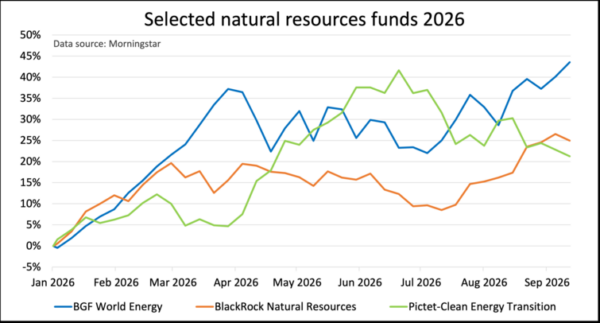
Pictet Clean Energy Transition was leading the three funds shown on the graph by June, having gained more than 40%.
Since then, it has fallen back sharply. BGF World Energy has moved in the opposite direction and is now ahead, while BlackRock Natural Resources has followed a noticeably steadier path. That doesn’t mean a broader fund will always be less volatile. However, it does illustrate a potential benefit of spreading exposure across several natural resource themes rather than relying on one of them.
That distinction is particularly relevant at the moment. Gold has already made substantial gains, copper is at record levels, and higher oil prices have given traditional energy another boost. These moves are not being driven by exactly the same factors, but several commodity-related themes are now performing well at the same time.
Commodities and natural resource funds can be volatile, and the strongest areas can change quickly.
Oil prices could retreat if geopolitical tensions ease, while metals can respond sharply to changes in supply or expectations for economic growth.
The performance of Pictet Clean Energy Transition this year shows how quickly a strong trend can reverse.
However, the latest numbers suggest that this sector is worth keeping on the radar. The IA may not provide an average return for the sector, but looking at the range of funds within it makes it easy to understand why.
In this case, following the individual funds and the changing trends beneath them probably tells a much more useful story.
For more information about Saltydog, or to take the two-month free trial, go to www.saltydoginvestor.com
Leave a Reply
You must be logged in to post a comment.