Mar
2026
Schroder Asian Total Return – why a total return approach works in Asia
DIY Investor
1 March 2026


How a total return mindset can help investors access Asia’s long-term opportunities
Asia offers some of the most compelling long-term opportunities in global equity markets, but it can also be unpredictable. Its economic growth potential is well recognised, but this doesn’t necessarily translate into positive stock market performance. The region’s income credentials may be less well understood, even though many companies now combine strong balance sheets with growing dividends and capital discipline.
In a region as large and diverse as Asia, selectivity is critical. Active managers who know the region well can add meaningful value by focusing on the most attractive businesses and managing risk carefully. This article explores why a total return approach – blending growth, income and disciplined risk management – offers a resilient way to harness Asia’s potential.
Growth – an evolving landscape of opportunity
Many of Asia’s economies have demonstrated a consistent ability to grow faster than their more mature counterparts in North America and Europe, supported by favourable demographics, urbanisation and rising household incomes. Alongside the region’s established export industries, a new generation of consumer, financial and technology companies has emerged in recent years to serve expanding domestic demand.
For investors, this evolution means that Asia’s opportunities now extend well beyond the familiar manufacturing-led focus of the past. Active stock pickers can access businesses with durable growth drivers across a range of sectors – from global suppliers of semiconductors to regional banks and service companies linked to rising consumption.
‘Asia’s economies have demonstrated a consistent ability to grow faster than their more mature counterparts in North America and Europe’
The widening mix of industries and business models has, however, also brought greater dispersion in company performance, reinforcing the importance of selectivity in identifying sustainable long-term growth.
While the region’s overall growth outlook remains positive, it will not be uniform. Some larger economies may face structural challenges, whereas others continue to benefit from the rise of consumer demand, productivity gains and positive demographics. That makes selectivity critical – being in the right companies and the right markets will be essential to capturing Asia’s long-term potential.
Income – dividends as a mark of discipline
Dividend income has become an increasingly important part of the Asian equity story. Markets such as Australia and Singapore have long demonstrated a strong dividend-paying culture, but there is growing evidence that this is spreading to other parts of the region.
Governance standards have improved markedly in several markets, including China and Korea, and many companies now recognise that regular, growing dividends signal capital discipline and effective long-term stewardship. This shift has changed the character of Asian markets – where returns once came primarily from capital growth, an increasing share now comes in the form of dividends from companies that generate healthy cash flow and return it regularly to their shareholders.
‘management teams are focused on delivering sustainable shareholder returns’
There is clear evidence that this discipline pays off. In markets such as Australia and Singapore, where Schroder Asian Total Return has meaningful exposure, companies with a sustained record of dividend growth have tended to outperform those that have not demonstrated such capital efficiency. A strong dividend policy can therefore be seen not as a constraint on growth but as a marker of quality – a sign that management teams are focused on delivering sustainable shareholder returns.
For a total return investor, that combination of a good starting yield and the potential for sustained dividend growth is powerful. It provides a tangible income stream while allowing investors to benefit from the compounding of reinvested dividends over time – a stable foundation on which to build long-term wealth from Asia’s corporate progress.
Active and selective – turning diversity into advantage 
Asia is not a single, uniform market but a collection of economies with distinct growth profiles, sector compositions and investment characteristics. This diversity represents opportunity for active investors, but it also demands skill and discipline to navigate effectively.
The region’s financial markets have matured and are much deeper than they used to be, but they remain relatively inefficient. Research coverage and liquidity can be patchy, which often leads to valuation anomalies that experienced, well-informed managers can identify and capture.
The investment team behind Schroder Asian Total Return applies an unconstrained, benchmark-agnostic approach that is designed to take advantage of these inefficiencies.
‘the managers focus on businesses with strong competitive positions, robust balance sheets and management teams that allocate capital effectively’
Their process begins with detailed, bottom-up research to identify companies that combine durable business models with sensible valuations and sound governance.
Supported by Schroders’ extensive research network across the region, the managers focus on businesses with strong competitive positions, robust balance sheets and management teams that allocate capital effectively.
The managers view Asia through four key clusters – China / Hong Kong, Korea / Taiwan, Australia / Singapore, and India / ASEAN – each with distinct drivers and sources of return.
By investing selectively rather than broadly, the managers can avoid areas of structural weakness and concentrate capital in businesses with clear, long-term earnings potential. This selective, research-driven approach has been central to the trust’s ability to deliver attractive total returns while carefully managing risk.
Derivatives – smoothing the journey
Managing risk is an integral part of generating long-term returns, and for Schroder Asian Total Return, the use of derivatives (such as futures and options) can play a supporting role.
The portfolio managers employ a systematic, model-based framework to determine when market conditions may justify additional protection. The aim is to reduce volatility and preserve capital during downturns.
There are two strands to this approach. The strategic element draws on valuation-based models that assess the longer-term risk and return profile of each market.
When a market appears significantly overvalued, for example, the team can use index futures or options with the aim to reduce market exposure while retaining their underlying stock positions.
‘Managing risk is an integral part of generating long-term returns’
Meanwhile, the process also offers a tactical overlay which operates over a shorter time horizon, guided by proprietary indicators that assess sentiment and momentum across the region.
Together, these tools allow the managers to take measured, cost-effective steps to protect the portfolio without diluting its long-term growth potential.
Asian equity valuations have historically cycled through long expansions and corrections. That volatility highlights why the team’s disciplined use of derivatives remains a valuable tool – helping to smooth returns, preserve capital and allowing investors to stay invested through market cycles.
Conclusion – capturing total returns with discipline
For Schroder Asian Total Return, this approach brings together the elements that can matter most in Asian equity investing: structural growth, an expanding universe of income-paying companies and the selectivity to focus on long-term value creation.
‘structural growth, an expanding universe of income-paying companies and the selectivity to focus on long-term value creation’
By combining disciplined stock selection with an effective framework for managing risk, the strategy aims to capture Asia’s potential while limiting the impact of market volatility.
For investors, that balance between opportunity and discipline offers a compelling proposition – access to Asia’s long-term growth, delivered through a strategy built to successfully navigate the inevitable ups and downs of markets.
Click here to visit the Schroder Asian Total Return homepage >
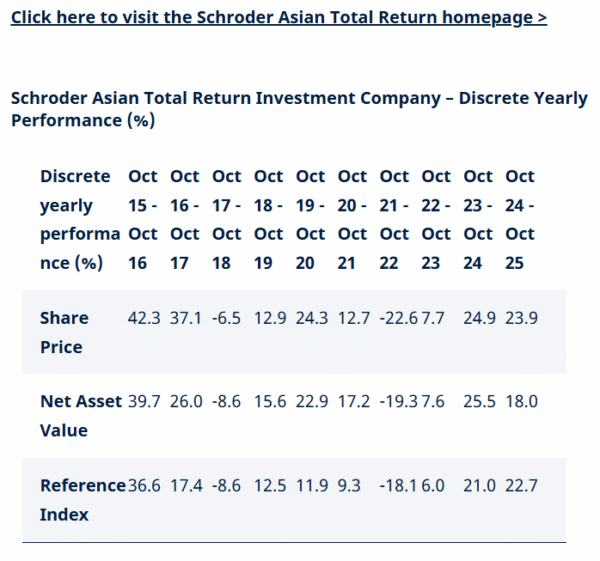
Schroder Asian Total Return Investment Company – Discrete Yearly Performance (%)
Why invest in ATR?
The Schroder Asian Total Return provides an unconstrained approach to investing in Asian markets, seeking to provide a total return to investors while providing an element of capital protection.
Behind the trust: read our philosophy article >
Marketing material
Please remember that the value of investments and the income from them may go down as well as up and investors may not get back the amounts originally invested.
Issued by Schroder Unit Trusts Limited, 1 London Wall Place, London EC2Y 5AU. Registered Number 4191730 England.
For illustrative purposes only and does not constitute a recommendation to invest in the above-mentioned security / sector / country.
Schroder Unit Trusts Limited is an authorised corporate director, authorised unit trust manager and an ISA plan manager, and is authorised and regulated by the Financial Conduct Authority.
Before investing in an Investment Trust, the latest Key Information Document (KID) at www.schroders.co.uk/investor or on request.
For help in understanding any terms used, please visit address https://www.schroders.com/en-gb/uk/individual/glossary/
Alternative investments Latest » Brokers Commentary » Investment trusts Latest » Latest » Uncategorized
Leave a Reply
You must be logged in to post a comment.