Mar
2026
Dollar at 5-week high on Iran tensions, yet history shows –0.19% average return in month one of conflicts
DIY Investor
2 March 2026
As U.S. and Israeli strikes on Iran send investors scrambling for safety, a critical question emerges: which safe-haven assets actually deliver when geopolitical crises erupt?
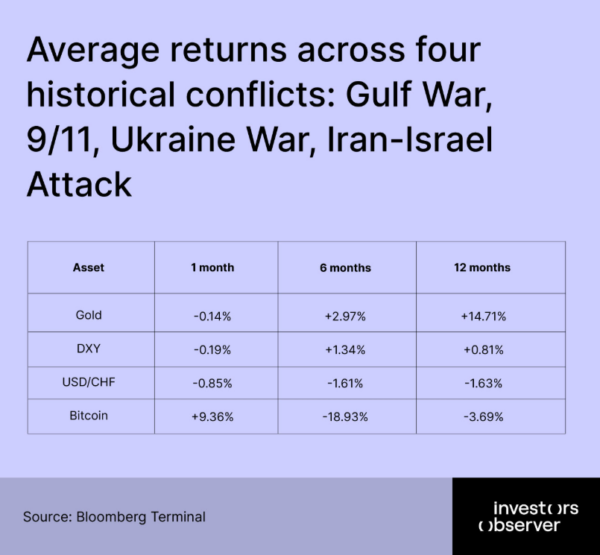
Investors Observer analyzed the performance of gold, the U.S. dollar, the Swiss franc, and Bitcoin across five major conflicts – from Iraq’s invasion of Kuwait in 1990 to Operation Rising Lion in 2025. We tracked returns at 1-month, 6-month, and 12-month intervals to separate crisis-hedge reality from market myth.
The findings challenge conventional wisdom: the dollar’s safe-haven status is inconsistent, gold can fail during rapid de-escalations, and only one asset has appreciated in 100% of conflicts analyzed.
Key findings
- Gold fell 3.17% during Operation Rising Lion in 2025, breaking a decades-long pattern of crisis-driven gains, because rapid conflict resolution eliminated the geopolitical premium.
- U.S. Dollar Index (DXY) averaged –0.19% in the first month of conflicts and fell 5.5% over 12 months after the 2024 Iran-Israel attack.
- Swiss Franc (CHF) appreciated vs. USD in every single conflict analyzed, spanning from World War I to 2025.
- Bitcoin fell 43.3% during Ukraine but rose 0.42% during the 2025 Iran escalation.
Gold
Gold has consistently served as the main crisis hedge, averaging 0.30% gains in the first week and 8.98% over 12 months across historical conflicts. Its appeal stems from tangible value perception and low correlation to equities, as seen during the Gulf War (+0.76% weekly) and 9/11 (+1.12% weekly), where investors prioritized inflation hedges amid uncertainty.
Physical demand surges and central banks buying further amplified returns during prolonged tensions, such as the 2024 Iran-Israel conflict’s 35.8% annual gold surge.
However, gold’s status fractured during Operation Rising Lion, declining 3.17% despite the S&P 500’s rally. This divergence highlights two vulnerabilities: (1) rapid conflict resolution diminishes gold’s short-term appeal as a crisis insurance asset, and (2) Bitcoin’s emergence as a digital alternative may fragment capital flows traditionally directed to gold.
“The anomaly signals that gold’s reliability is contingent on conflict duration and the availability of competing havens,” said Sam Bourgi, senior analyst at InvestorsObserver.
U.S. Dollar Index (DXY)
Contrary to assumptions of dollar strength during crises, the DXY averaged a 0.19% 1-month decline historically, with mixed results across events.
For instance, it fell 5.7% during the 2024 Iran-Israel conflict as investors favored gold and oil, while rising 11.9% in the Ukraine War’s first six months due to aggressive Fed rate hikes.
“This demonstrates that monetary policy often outweighs geopolitical drivers. The dollar’s sensitivity to interest rate differentials and global risk sentiment makes its safe-haven status context-dependent rather than universal,” said Bourgi.
During Operation Rising Lion, the DXY dipped 0.30%, extending its inconsistent crisis performance. This reinforces that dollar strength is not automatic during wars.
Factors like U.S. debt dynamics, trade imbalances, and competing currency flows (e.g., Swiss Franc appreciation) can neutralize or reverse typical haven flows.
Investors should monitor real yields and global liquidity conditions alongside conflict developments when assessing dollar exposure.
Swiss Franc (USD/CHF)
The Swiss Franc appreciated against the dollar in 100% of analyzed conflicts, averaging 0.85% monthly gains – a track record spanning World War I to the 2025 Israel-Iran escalation.
“This consistency stems from Switzerland’s political neutrality, robust financial system, and the franc’s historical role as a “clean” haven uncorrelated with reserve currency policies. Even during Operation Rising Lion, the franc gained 0.25% as investors prioritized sovereign stability over dollar liquidity,” explained Bourgi.
The franc’s resilience is further validated by its inverse correlation to the DXY during crises. For example, it rose 2.9% while the dollar fell 5.5% in the 12 months following the 2024 Iran-Israel conflict.
This reliability positions the franc as a pure-play geopolitical hedge, though its low yield and SNB intervention risks (e.g., currency caps) require tactical entry points for optimal allocation.
Bitcoin
Bitcoin’s limited crisis dataset (available post-2022) reveals extreme volatility: it plunged 43.3% over six months during the Ukraine War but gained 32.1% in the year following the 2024 Iran-Israel strikes.
This divergence reflects Bitcoin’s dual identity as both a risk asset (correlating with tech stocks) and an emerging digital haven during currency devaluation fears, particularly in regions with capital controls.
During Operation Rising Lion, Bitcoin rose 0.42% – outperforming gold and the franc but trailing the S&P 500. This suggests its haven appeal is strengthening in short, digitally connected conflicts where investors seek assets outside traditional financial systems.
However, Bitcoin’s 2025 performance (+0.42%) versus its 2022 crash (-43.3%) reveals that its efficacy remains event-specific and highly sensitive to regulatory sentiment and market liquidity conditions.
Methodology and sources
Performance data was sourced from the Bloomberg Terminal, with calculations beginning on the event start date for each asset.
Returns reflect price changes only, excluding dividends or currency adjustments.
Leave a Reply
You must be logged in to post a comment.