Oct
2026
The Times They Are A-Changin’: On The Road to Nowhere
DIY Investor
7 October 2026
 “Well, we know where we’re goin’
But we don’t know where we’ve been”
The Tories might appear more united than they have in recent years, with MPs finally realising that voters don’t appreciate party changing leaders on an on-going basis; five in the past eight years.
This summer’s funding travails of Farage’s Reform has given them reason for hope, with some Tory MPs confident they have peaked.
Others, possibly more plugged into what is going on in their constituencies, still view them as a threat, and are concerned about the party continually listing to the right.
Despite all of this positivity, almost two years after Badenoch was elected as leader, the party is still polling lower than in their catastrophic general election defeat in 2024. YouGov shows the Tories on 19%.
‘the party is still polling lower than in their catastrophic general election defeat in 2024’
They are also a party of the old: 30% of over 65’s support them, compared to only 7% of those aged 18-24 yrs, and 13% of those aged 25-49.
Their continual listing to the right has alienated more centrist voters, and these will needed if they are to stand a chance of winning another election. Within this there is a need to focus more on the economy instead of culture wars.
The following electoral map shows how previously safe seats in the South, “the blue wall”, were lost to the LibDems.
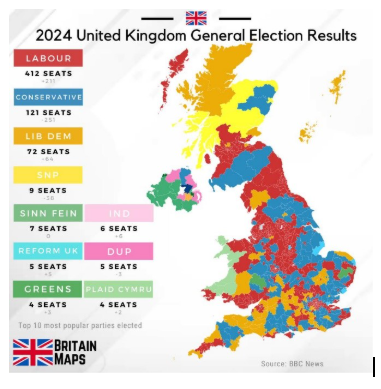
The issue is that Badenoch doesn’t seem bothered by this. Instead she seems focussed on, unsuccessfully, wooing Reform voters. The more she leans right, the more she alienates home counties moderates, without whom she has little chance of winning an election.
Voters who are dissatisfied with immigration, the economy and the NHS are disproportionately moving to Reform. This could be due to the Tories still being blamed for their previous record in government, or by Reform’s message appealing more to those voters.
Badenoch is far too taken-up with her perceived self-importance: “I march to the beat of my own drum”. This is all very well, but she is out-of-step with the public, polling at -15% compared to PM Burnham’s +7%.
More moderate, “One Nation Tories”, are history, as the removal of the Lords whip from Gavin Barwell, Theresa May’s chief of staff, shows. Barwell’s crime was to oppose Badenoch’s edict barring any candidate who supports net zero carbon emissions or staying in the ECHR, to which he said: “I haven’t left the Conservative party. It has left me.”
The cost-of-living crisis appears to have passed her by, as she focuses on those hard-pressed parents earning over £100,000 offering them free childcare, at the cost of £700m. This 4% of the population; they might not think they are wealthy, but the other 96% do.
The children of this elite 4% are estimated to be 8x more likely to benefit from funded childcare hours than the most disadvantaged, says the New Economics Foundation. All Badenoch will create, is tomorrow’s Neets.
Instead, Kemi prefers to cut some benefits to “subsistence” level deliberately implying that the 4-million children living below the poverty line are living la dolce vita. All of this is part of the £47bn in cuts, her shadow chancellor “in every part of government”
Turning to the failed-Brexit, whilst 70% want closer relations with the EU, she prefers to endanger any agreement with threats to reverse-it, meaning that any renegotiations are at risk of failure before they even begin!
‘All Badenoch will create, is tomorrow’s Neets’
Badenoch’s Tories are history and living it; the shadow chancellor, Andrew Griffith, explained away the 14-yrs of failure between 2010-24, as the result of the party straying from Thatcherite principles.
Lest we forget, Griffith was a member of Truss’s disastrous Treasury team. He seems to have learnt little in the intervening years, as he continues to support lower taxes, welfare reform and deregulation.
The only difference is that these measures will be funded by shrinking the state with the afore mentioned £47bn of cuts. There was, however, no explanation as to whether growth would be sufficient to offset its effect on demand and productive capacity.
Whilst we aren’t yet in the same situation as Spain and France, many people, especially the young, are still disillusioned
In Spain, tens of thousands of people in 50 cities have taken to the streets to protest about the country’s housing crisis. One banner said: “You can speculate on watches, jewels, crypto-bros and Ferraris. But not on our fucking homes.”
“You can speculate on watches, jewels, crypto-bros and Ferraris. But not on our fucking homes.”
Rents have risen by 80% in a decade, however the last straw appears to have been the high-profile eviction of an 87-year-old wheelchair bound woman in Madrid, after an investment fund increased her rent by 230%. Many are spending more than half their income on housing, and enough was enough.
In France, as I wrote in “Aux Barricades”, school pupils are rioting with slogans including: “More hours in class than for sleep”; “Fund study, not repression”; “I’d like to be worrying about my maths exam, not my future”.
These, predominantly youth-led protest, highlight a growing problem for western European governments: a generation of young people feeling increasingly denied the basic socioeconomic security that, by and large, their parents enjoyed.
‘a generation of young people feeling increasingly denied the basic socioeconomic security that, by and large, their parents enjoyed’
Taken together, the two crises highlight some core problems facing mainstream governments. Young people in particular have come to see incremental measures – targeted tax credits, minor administrative reforms – as mere placebos that fail to address deeper socioeconomic issues. A situation that radical politicians have been quick to take address.
On the left, France’s Jean-Luc Mélenchon – backed by 47% of voters under 35 – has sided openly with the street, while in Spain, leftwing parties Podemos and Sumar have blamed the housing crisis squarely on out-of-control financial capitalism.
Right-wing parties, obviously, feel that governments are punishing landlords unfairly, and fear for law and order/
A 26-year-old protester in Madrid, summed-up the situation perfectly: “it is us, the people, who have to adapt to the political parties – and not the politicians who have to adapt to what the people want. It can’t go on like that.”
“Are teenage dreams so hard to beat”
A half-way house take on the Tory party conference.
In essence, the conference has only served to highlight why their popularity is low and staying low: 1:5 of the electorate.
Isolating voters demographically, this improves to 1:3 of 65’s+, but 1:10 of those 49 and younger. It’s a party for dinosaurs led by one.
Free-child care for families earning £100k+ shows how out of touch they are.
They are still fixated with tax cuts, this time funded by the usual illusory benefits cuts; are there any left to cut? They will say yes, as they are equally fixated by malingers draining the state’s coffers.
The red wall won’t vote for them again, they might be socially conservative but they are economically the opposite. This is why Reform’s smoke and mirrors has them fooled.
Don’t believe me? Ask a MAGA supporter, they will tell you all that glitters isn’t gold.
Take Reform MP for Runcorn and Helsby, Sarah Pochin, who, in June, submitted a written question to the housing minister Matthew Pennycook, asking: ““what assessment he has made of the potential impact of second home ownership on housing availability in coastal and rural communities”.
Two-days later she completed on the purchase of an £800K Grade-II listed property on the southern coast of Anglesey (Ynys Môn), a picturesque Welsh island.
We are mired in a sea of division: young and old; north and south; progressive and regressive culture warriors. But, there is one real division: haves’ and have nots’!
Across the channel in France and Spain, this is the battle that has started.
Lyrically, we start with “Road to Nowhere” by Talking Heads, and finish with “Teenage Kicks” by The Undertones.
Read it and weep!
Philip.
@coldwarsteve
Philip Gilbert is a city-based corporate financier, and former investment banker.
Philip is a great believer in meritocracy, and in the belief that if you want something enough you can make it happen. These beliefs were formed in his formative years, of the late 1970s and 80s
Click on the link to see all Brexit Bulletins:

Leave a Reply
You must be logged in to post a comment.