Jul
2026
The investment outlook for the second half of 2026
DIY Investor
26 July 2026
Markets should continue to show resilience – by David Brenchley
We are now more than halfway through 2026 and we’ve seen some seismic events occur already around the world that have been hugely consequential for global markets. Heavy spending on artificial intelligence (AI) continues and has already started to shift the tectonic plates within stock markets.
Software has so far been the most consequential victim, though the so-called hyperscalers have also borne some brunt. As the Magnificent Seven have underperformed, market leadership has shifted to the ‘picks and shovels’ of the AI ecosystem, namely the semiconductor firms that make, design and/or supply the chips that are crucial in powering AI.
Conflict in the Middle East has conspired to shut the Strait of Hormuz, a key waterway through which, in normal times, c. 20% of the world’s oil and liquefied natural gas (LNG) flows. Today, that flow has slowed to a trickle and has raised c. 40% in the year to 20/07/2026.
Amid this, we’ve been treated to a record-breaking IPO from Elon Musk’s rocket-launching firm SpaceX, which raised $86bn (£64bn) from public market investors in June. Markets have been surprisingly resilient, a fact cheered by both Invesco and Fidelity.
In its mid-year outlook, Invesco said: “The first half has seen a host of events with the potential to disrupt global economies and markets in a world that appears increasingly fragmented. Yet economic data and corporate results suggest the global economy remains resilient.”
The firm said that it expects the global economy to re-accelerate later in 2026, though it cautioned that this depends on when energy starts flowing again, adding that “the longer the Strait of Hormuz remains closed the more challenging the growth and inflation mix will become”.
Fidelity argues that this steadfastness is unsurprising, given markets have “become well-versed in seeing through the noise and recognising upside”. “An immense AI capex cycle, strong earnings, and relatively strong fundamentals across markets have reassured investors that there’s still plenty of alpha to be captured.”
Spend, spend, spend
That brings us nicely onto the question of AI, which has, as we said earlier, been powering markets for a few years now, ever since the emergence of ChatGPT. We’ve spoken about the sheer scale of AI spending before; now, we’re starting to get a sense of how things might play out in terms of the ultimate return companies might get from their AI investments.
Question marks remain and that’s to be expected, especially when the ramping up in hyperscaler capex has almost inevitably meant that hyperscalers’ free cashflow is now falling. JPMorgan notes that AI capex has gone from 33% of the hyperscalers’ cash flow from operations in 2023 to an estimated 93% in 2026. Ultimately, the hyperscalers must “demonstrate that demand is sufficient to deliver a positive return on investment and do so quickly enough to avoid placing too great a strain on existing cashflow” if they are to win back investors’ favour.
Fidelity’s Jonathan Tseng agrees, suggesting that either capex will need to come down or revenue and absolute free cashflow will need to go up. He sees good reasons why the latter will be the case. “The total addressable market for LLM spending is no longer the IT budget but the broader wage budget of the business world,” says Tseng.
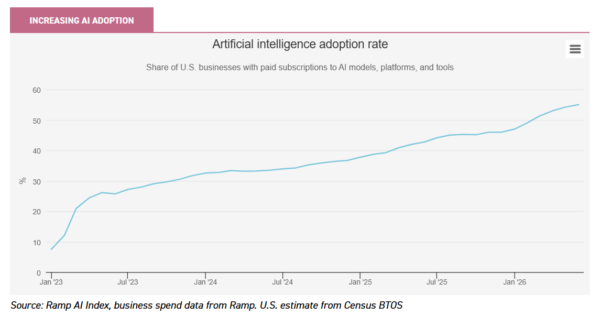
Many survey-based indicators, such as the Ramp AI Index, have highlighted increasing corporate adoption of AI, said JPMorgan. This is positive, as current tech stock valuations are predicated largely on AI becoming a powerful source of productivity and profitability across the whole global economy.
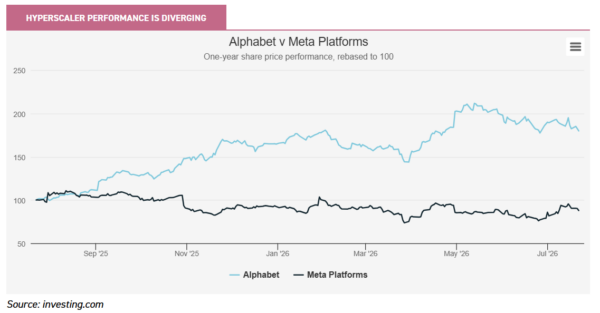
The firm is also reassured by the fact that we’ve seen a dispersion of returns within tech itself. Indeed, there’s been a near-100 percentage point difference in performance between the best-performing US hyperscaler (Alphabet) and the worst performing (Meta Platforms) in the 12 months to 17/07/2026.
This suggests investors are “scrutinising individual company fundamentals rather than placing options on the overall market, which would be more common behaviour in the late-stage euphoria of a bubble forming”.
It is, of course, still unclear who the ultimate winners will be, and the market will continue to hazard guesses.
The data centre build-out boom is key for Invesco. It thinks that bottlenecks in supply have driven pricing power for many semiconductor names, while simultaneously looking beyond chips and into companies providing networking, cooling and grid interconnection equipment.
In addition, owners of natural gas-fired turbines and nuclear energy are likely to benefit from data centre builders preferring to generate their own energy, while upward pressure will be exerted on prices for commodities such as copper and rare earth minerals, upon which much of the equipment used in data centres relies.
Fidelity sees some value in selected utilities that have exposure to data centre growth, noting that “escalating NIMBYism across the US will drive data centre growth to Texas, where there are no zoning laws outside cities and the state government and utility regulators are highly supportive of data centres”.
US or not US
The AI discussion brings us neatly onto the question of whether US exceptionalism will continue. We had seen some evidence that non-US equities might stage a comeback while the US underperformed (but still provided positive and eye-catching returns). Emerging markets were at the vanguard of this shift. For now, that looks to have been transitory and the US has retaken the initiative.
BlackRock thinks America will continue to outperform, reiterating an overweight to the US since, particularly US technology as the AI play. “Even if the ultimate [AI] winners are unclear, many are likely to be found [in the US].”
Interestingly, while noting there are specific AI plays outside of the US, BlackRock has downgraded broad emerging market (EM) equities from overweight to neutral after strong performance, given the largest companies in the EM index are tied to the same value chain (AI) as the largest US firms. Within the EM region, it prefers Latin America.
By contrast, Invesco thinks that both EM equities and EM debt will continue to outperform for a few key reasons. One is its exposure to the AI supply chain, noting that demand for data centre products has led to a boom in exports from South Korea and Taiwan in particular. Consensus forecasts for MSCI Korea earnings per share growth in 2026 is over 200%.
In terms of the oil price, there are a couple of possibilities. The higher energy prices go, the more the energy-exporting parts of the EM universe will benefit. If and when the Strait reopens and oil prices fall, this would give a boost to those energy importers, as well as seeing global economic growth re-accelerate, providing a potential boost to EMs.
Invesco’s final reason is that it expects the US dollar to continue falling. It argues that the US dollar is “one of the more overvalued currencies on most measures, and the fact it has not strengthened much in the face of the recent energy shock is telling”.
The firm also thinks the US Federal Reserve will restart its interest rate cutting programme during the second half of the year, which would pressure the US dollar. EM equities tend to outperform developed markets when the USD weakens.
There’s broad scepticism around China and few are shouting from the rooftops about Europe, given the continent’s lack of AI behemoths. JPMorgan calls UK equities “differentiated” with a “relatively attractive profile”, should their forecast of a weaker pound and less hawkish than expected Bank of England materialise. This “supports internationally exposed revenues, while dividend yields, undemanding valuations, and stronger free cash flow generation provide a solid foundation for total returns”, the firm said.
Fidelity said that it was underweight countries and sectors vulnerable to energy shortages such as Japan, but sees appeal in Japanese mid-caps. As Japan’s small-cap segment has outperformed the broader market thanks to shareholder governance reforms, Fidelity thinks mid-caps should start to do well, too. They noted that mid-caps are more domestically oriented, so less affected by geopolitical noise and better positioned to capture recovering local demand.
Changing diversifiers
One other clear theme running through the outlooks is the shifting sands when it comes to the non-equity part of a diversified portfolio. Historically, long-dated government bonds have successfully filled this spot, with the gold-standard balanced portfolio having been seen as 60% equities and 40% bonds.
“A simple split between bonds and equities will not protect investors through all the different inflationary regimes to come in this new era of investing,” said Fidelity.
One big worry is around long-dated government bonds, given the potential for inflation to remain at higher levels, as well as the sheer scale of government indebtedness. BlackRock thinks that after around 30 years of a great moderation in bond yields, we’ve entered a new regime of post-pandemic supply constraints that could keep inflation higher. If this is the case, bond yields that look optically high could prove anything but.
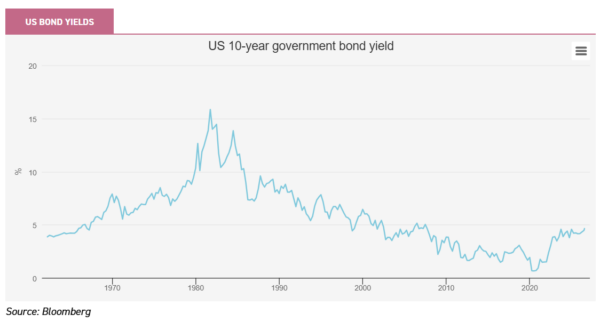
That said, bond yields have now “steadily reset higher around the world, making income an opportunity again”, according to BlackRock. “The key is how investors earn it,” they say. “We prefer pocketing income in shorter maturities over relying on long-term bonds”, for the reasons set out above. Others agree.
Fidelity also suggested considering inflation-linked bonds, which, as the name suggests, have the ability to protect against inflation.
On private credit, Invesco noted that while there are understandable concerns being raised, high-quality direct lending investments offer a relatively attractive risk-reward trade-off.
Elsewhere, real estate offers the possibility for good returns as well as diversification. “With similar volatility to government debt and investment grade credit, real estate has offered better returns over the period since 2005, with small negative correlation on average to other assets, which suggests it has been a diversifying asset,” Invesco said. “Interestingly, given the current environment, our historical analysis shows that real estate performs better than most assets when inflation is rising.”
JPMorgan thinks that if inflationary concerns become more systemic, then “investors will seek protection in assets that can’t be printed”. These include infrastructure (as mentioned), transportation assets, and real estate, which all “sit at the centre of resilience, supply-chain security, energy security, and domestic capacity building”.
“They also offer a useful hedge in a more inflationary world, with tangible replacement value, long-duration cash flows, and potential inflation linkage through rents, contracts, or regulated returns.”
One final asset to consider is commodities, which “has historically helped protect investors through inflationary environments since these are real assets tied to rising input costs, and because of their lower correlations with other assets”, said James Richards, a fund manager at Fidelity.
“For investors concerned about concentration in consensus trades, such as AI capex winners, commodities introduce differentiated return drivers, enhancing portfolio diversification,” Richards added.
Overall, the resilience markets have shown in the face of numerous storms so far this year has certainly reassured most fund groups. Indeed, with expectations of record earnings to come further down the line, “now is not a time to shy away from risk; only to ensure it’s balanced in a well-diversified portfolio that will cushion the inevitable shocks when they come”, said Fidelity.

Disclaimer
This is not substantive investment research or a research recommendation, as it does not constitute substantive research or analysis. This material should be considered as general market commentary.
Alternative investments Commentary » Brokers Commentary » Commentary » Equities Commentary » Exchange traded products Commentary » Fixed income Commentary » investment trust commentary » Investment trusts Commentary » Latest
Leave a Reply
You must be logged in to post a comment.