Jun
2026
The Times They Are A-Changin’: Why Inequality is the Single Biggest Problem we Face
DIY Investor
5 June 2026
 “It’s been twenty-two long, hard years, I’m still strugglin’
Survival got me buggin’, but I’m alive on arrival”
UNESCO defines inequality as “….the unequal distribution of resources, opportunities, or privileges among individuals or groups in society”.
Putting aside social inequality such as gender, ethnicity, age, or disability, there is:
- Economic Inequality: The uneven distribution of income and accumulated wealth, including the “wealth gap” between the highest and lowest earners.
- Inequality of Opportunity: When a person’s life trajectory is limited by factors beyond their control, such as family socioeconomic status, race, or geography.
Inequality in the UK is characterised by severe wealth gaps, significant regional disparities, and disproportionate struggles for younger generations. While income inequality has remained relatively stable since the 1990s, the OECD ranks the UK as the 9th most unequal among its 38 member countries
Income inequality:
- The Gini coefficient stands at 33% (before housing costs) and 37% (after housing costs).
- The top 20% of the population receive C.35% of all disposable income, while the lowest 20% receives only 8%.
Wealth inequality:
- The top 10% of households own 5x the wealth of the bottom 50% combined
- The bottom 50% own less than 5% of the country’s total wealth.
Research by World Bank found that inequality has encouraged populism in the UK, however our unique economic and political landscape channels this inequality into distinct populist outcomes.
Unlike some European countries where populism is fuelled by a general economic decline, UK populism is based around regional inequality. The prolonged economic neglect of deindustrialised areas such as the “Red Wall” has been a stronger driver of populism.
‘UK populism is based around regional inequality’
It should be noted that Red Wall was created out of Thatcher’s deindustrialisation, which itself was driven by neoliberalism’s theory that market-forces know best. The same can be said of the Rust Belt in the US, which Trump won in both 2016 and 2024.
Whilst deindustrialisation in the UK started in the 1950’s as we began to loose ground to emerging economies, it gathered pace in the 1980’s as Thatcherism effectively supported it.
As the graph below illustrates, as deindustrialisation picked-up pace inequality, which had been declining, began to increase.
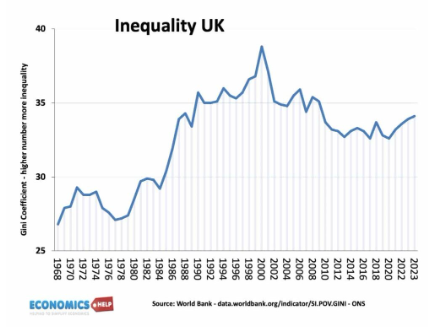
Political research by CEPR suggests that this is further exacerbated by our lack of social mobility across generations, which has caused communities to feel excluded from economic and political structures, creating anti-establishment resentment.
The populist message of both Reform and Restore is based around immigration, and the belief that stopping it will create jobs for the native-born. In Trump’s America, despite ICE doing their best to deport everyone, job creation, and the employment rate for native-born adults is lower, not higher, than previously; falling from 59.6% in 2024 to 58.2% year-to-date.
However, it will likely take more than this to keep a racist in-check. Research published this week as part of the British Social Attitudes survey shows the ideological gulf between Farage’s supporters and the rest. His supporter are less satisfied than the median voter with the economy and public services, and are much more likely to think benefits are too generous and that the whole political system is failing.
However, they come into their own when it comes to social resentments; 75% believing that immigrants undermine our national culture, compared with 35% of the wider public.
‘they come into their own when it comes to social resentments; 75% believing that immigrants undermine our national culture’
Reforms attitude to the establishment was summed-up by Zia Yusuf, who said: “Recent events demonstrate why I view the Tory and Labour politicians who created the burning injustice of modern Britain as traitors to their country. A reckoning is coming.”
Quite what this reckoning is he doesn’t say. However, if we look across the Atlantic we can see how Trump is taking America towards authoritarianism, concentrating power with himself, silencing the media, attacking voting rights, politicising federal bureaucracy, weaponising the justice system against his opponents and deploying the National Guard into Democratic cities.
There is nothing to say this couldn’t happen here; we have no codified constitution, no first amendment-style protection of free speech, no state governments, no federal courts. Parliamentary sovereignty means that any party with a majority faces few obstacles to implementing authoritarianism. The House of Lords is an unelected second chamber which can be neutralised, indeed Reform proposes replacing it “with a much smaller, more democratic second chamber.”
Reform also plans to leave the European court of human rights and to repeal the Human Rights Act. This would leave their proposed version of ICE unchecked and able to orchestrate a mass deportation programme targeting both undocumented migrants and those with indefinite leave to remain.
‘Reform are weaponising race to aggravate peoples base instincts, inciting fear and disunity’
As events this week have shown, Reform are weaponising race to aggravate peoples base instincts, inciting fear and disunity. None of this will deal with rising inequality, it merely provides someone to blame.
As West Streeting wrote; to achieve this governments need to acknowledge that inequality isn’t incidental to the crises reshaping western democracies, is actually the cause.
People are rebelling because they cannot afford a home. Young people are told that opportunity exists even though they face lower living standards than their parents enjoyed. They are told to work harder while wealth continually accumulates for the few.
‘Britian today lacks social stability, climate stability, consistency in the provision of public services, the breakdown of the established traditional two-party system, the shortcomings of our electoral system, and of faith in democracy itself’
We are no longer a meritocracy, we have returned to the days when inherited wealth determined your future.
Capitalism, in its current form, is failing, serving the minority at the expense of the majority.
Perhaps it is time to challenge the bond vigilantes, and reflate our moribund economy.
The bond market, we are told values stability. Yet, Britian today lacks social stability, climate stability, consistency in the provision of public services, the breakdown of the established traditional two-party system, the shortcomings of our electoral system, and of faith in democracy itself.
In conclusion, all we can say is that market-friendly neoliberalism followed by austerity has delivered little other than inequality and instability.
“It was me, waiting for me
Hoping for something more”
No apologies if today’s article is seen as a rehash of what has gone before. This column has championed inequality for the past 8-yrs and will continue to do so whilst it shapes and influences our politics.
This weeks scenes of violence in Portsmouth were the expected reaction to inflammatory comments from politicians intent on sewing discontent. The usual hard-right rent-a-mob were there. Perhaps they were getting in-training for the forthcoming World Cup?
On that subject, the BBC documentary “Dear England” is well worth watching.
Its star, Gareth Southgate, was a decent bloke, who did a better than expected job as England manager. Moreover he got it; he understood the racism his players had to deal with, and that togetherness is a key. Not just for a team, but for society.
Clearly the police have gone too far the other way in policing racist incidents. Is it two-tier policing? A better question might be, when wasn’t it two-tier policing? If anyone doubts that, ask any black person.
It shouldn’t be “black lives matter” or “white lives matter”, it is “all lives matter”.
Lyrically, start with Notes “C.R.E.A.M” (Cash Rules Everything Around Me) by Wu-Tang Clan, and end with “New Dawn Fades” by Joy Division.
Enjoy!
Philip.
@coldwarsteve
 Philip Gilbert is a city-based corporate financier, and former investment banker.
Philip is a great believer in meritocracy, and in the belief that if you want something enough you can make it happen. These beliefs were formed in his formative years, of the late 1970s and 80s
Click on the link to see all Brexit Bulletins:

Leave a Reply
You must be logged in to post a comment.